A traffic jam is made of cars, but no individual car contains a traffic jam. Temperature belongs to a collection of moving particles, not to one isolated particle in the ordinary thermodynamic sense. A flock turns as a coherent shape even though no bird carries a blueprint of the whole formation. These are legitimate reasons to talk about emergence: organized behavior can appear at one scale that is not usefully described in the vocabulary of another.
The trouble begins when the word is asked to do more than mark the phenomenon. “Consciousness emerges from the brain” may be true in a broad dependency sense. It is not yet an account of how neural activity is related to subjective experience. “Intelligence emerges from scale” may describe an observed capability curve. It does not identify which representations, training signals or interactions produced the capability—or when it will fail.
What scientists usually mean by emergence
There is no single definition accepted across physics, biology, philosophy and computer science. The common core is scale: a system displays a regularity, capacity or organization that is not a property of its components considered separately. The macro-pattern depends on the micro-organization, but describing each component may be a poor way to predict or understand the collective behavior.
Philip Anderson's 1972 essay “More Is Different” argued against a simple constructionist dream: even if fundamental laws are known, rebuilding the concepts needed at every larger scale is not automatic. Broken symmetry, collective order and new organizing principles make chemistry more than applied particle physics in practice, and biology more than an exercise in listing chemical equations.
That argument is not mystical. It does not require new matter to enter the system. It says that derivation, prediction and understanding are different achievements. Knowing the rules governing water molecules does not let an unaided mind look at a trillion coordinates and immediately see a hurricane. Higher-level variables can be indispensable because they compress structure that matters.
Weak and strong emergence are different claims
Philosophers often distinguish weak emergence from strong emergence. In a weak case, the higher-level behavior follows from the lower-level rules, but may be difficult to derive except by running the system or using a specialized model. Cellular automata provide clean examples: simple local rules can produce moving structures whose behavior is obvious after simulation but hard to infer by staring at a rule table.
Strong emergence makes a larger claim: the higher-level property is not fully reducible to, deducible from or determined by lower-level facts, and may possess genuinely novel causal powers. The Stanford Encyclopedia of Philosophy's survey of emergent properties documents how contested these formulations remain. Much disagreement comes from using different standards for derivation, novelty, explanation and causation.
Those categories should not be smuggled into one another. Evidence that a neural network develops a capability not explicitly programmed by a human supports an ordinary organizational sense of emergence. It does not establish strong metaphysical emergence. Evidence that a behavior is difficult to predict does not show that it is impossible in principle to derive.
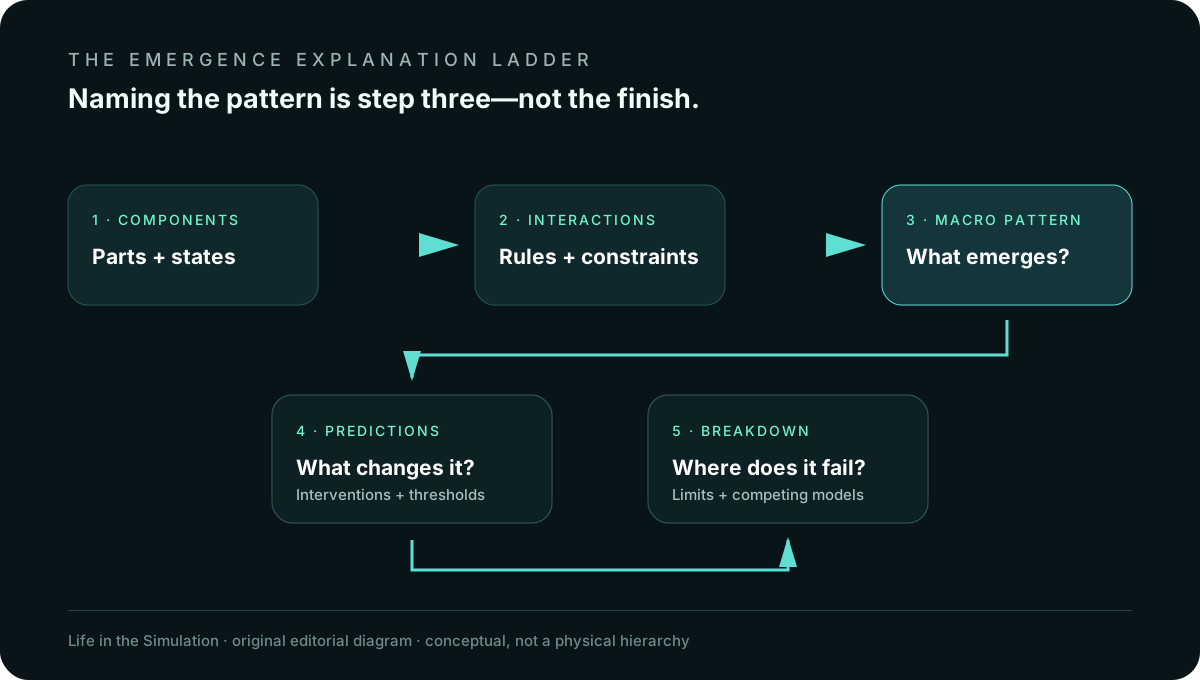
What a real emergent explanation contains
- Components. What entities or processes make up the system at the relevant lower level?
- Interaction rules. How do those components influence one another? Local feedback, competition, alignment and inhibition often matter more than the parts list.
- Boundary conditions. What energy, environment, geometry, training data or institutional constraints keep the pattern possible?
- Order parameter or macro-variable. What higher-level quantity captures the pattern without merely describing it poetically?
- Bridge mechanism. Why do the interactions generate this macro-state rather than another?
- Predictions and breakdown. Under what intervention should the pattern strengthen, change phase or disappear?
A phase transition earns explanatory depth because temperature, pressure, interactions and symmetry can be connected to a change in collective order. “A crowd panicked because panic emerged” does not. The latter statement repeats the event in abstract language while leaving transmission, incentives, density and feedback untouched.
Why emergence does not solve consciousness
Most scientific work on consciousness assumes that experience depends on organized biological processes. Damage, anesthesia, stimulation and changing brain states provide powerful evidence of dependence. Calling consciousness emergent can therefore express a reasonable research commitment: examine organization and dynamics rather than search for a tiny conscious particle.
But dependence is not identity, and correlation is not a bridge theory. The central difficulty described in Consciousness Is Still the Weird Part remains: why should any physical or functional process be accompanied by felt experience? A theory may instead dissolve that question, explain access and report while treating phenomenal residue as confused, or posit additional principles. Researchers and philosophers disagree. “Emergence” does not choose among them.
This is not an argument for supernatural causes. It is an argument against declaring victory at the label. A disciplined physicalist can say both that consciousness depends entirely on brains and that the explanatory bridge remains incomplete.
The same caution applies to artificial intelligence
Capabilities in large models are often called emergent when performance appears abruptly as scale, data or prompting changes. Some apparent jumps are sensitive to the metric: a smooth increase in underlying probability can look discontinuous when converted into pass/fail accuracy. Other transitions may reflect real threshold effects in learning or representation. The empirical question must be measured, not settled by the adjective.
A system's unexpected competence also does not prove humanlike understanding. As A Model Can Be Right for the Wrong Reason argues, accuracy can rest on shortcuts that fail under distribution shift. The useful follow-up is mechanistic and behavioral: which inputs matter, which interventions change the result, and which neighboring tasks expose the limit?
Emergence and the simulation hypothesis
Emergent order is compatible with many substrates. A cellular world, biological universe or computer simulation could all contain higher-level patterns. The existence of emergence therefore does not discriminate between simulated and nonsimulated reality. Nor does unexplained complexity count as a rendering artifact. That leap repeats the mistake examined in What Would Count as Evidence That Reality Is Simulated?: assigning an anomaly to a favorite explanation without showing a prediction unique to it.
A six-question test for emergence claims
- What exactly is the higher-level property?
- Relative to which lower-level description is it novel?
- Is the claim about practical unpredictability, conceptual irreducibility or new causation?
- Which interactions and constraints produce the pattern?
- What intervention would alter or destroy it?
- What explanatory work remains after the word emergent is removed?
If the last answer is “all of it,” the claim is a placeholder. Placeholders are allowed. Science begins with names for patterns. Intellectual honesty requires keeping the name visibly provisional.
What is established, disputed and open
Sourced fact
Collective systems display stable higher-level regularities, and many sciences require concepts that are not practical restatements of fundamental equations.
Expert disagreement
Researchers disagree about whether emergence is merely epistemic and computational, whether some properties are strongly emergent, and what causal autonomy higher levels possess.
Reasonable inference
An emergence claim becomes more informative when it specifies organization, mechanism, predictions and failure conditions.
Speculation
Conscious experience may ultimately require a new bridge principle, a deeper functional account or a revision of the question. Current evidence does not settle which.
Sources and boundary
- Anderson, P. W. (1972), More Is Different, Science 177(4047).
- Wilson, J. (2021 revision), Emergent Properties, Stanford Encyclopedia of Philosophy.
- Gu, M. et al. (2009), More Really Is Different, a formal result about limits on deriving macroscopic observables in an Ising setting.
This essay distinguishes an explanatory strategy from a metaphysical verdict. It does not claim that higher-level sciences are independent of physics, or that consciousness has been shown to possess nonphysical causes.
END OF TRANSMISSION 027
Keep the question. Test the model.
Choose the narrowest claim the evidence can carry, then leave room for revision.