A memory can arrive with the force of a recording. The room appears. A sentence returns in a familiar voice. The sequence feels intact. That vividness is psychologically real. It is not evidence that the mind stored and replayed a complete audiovisual file.
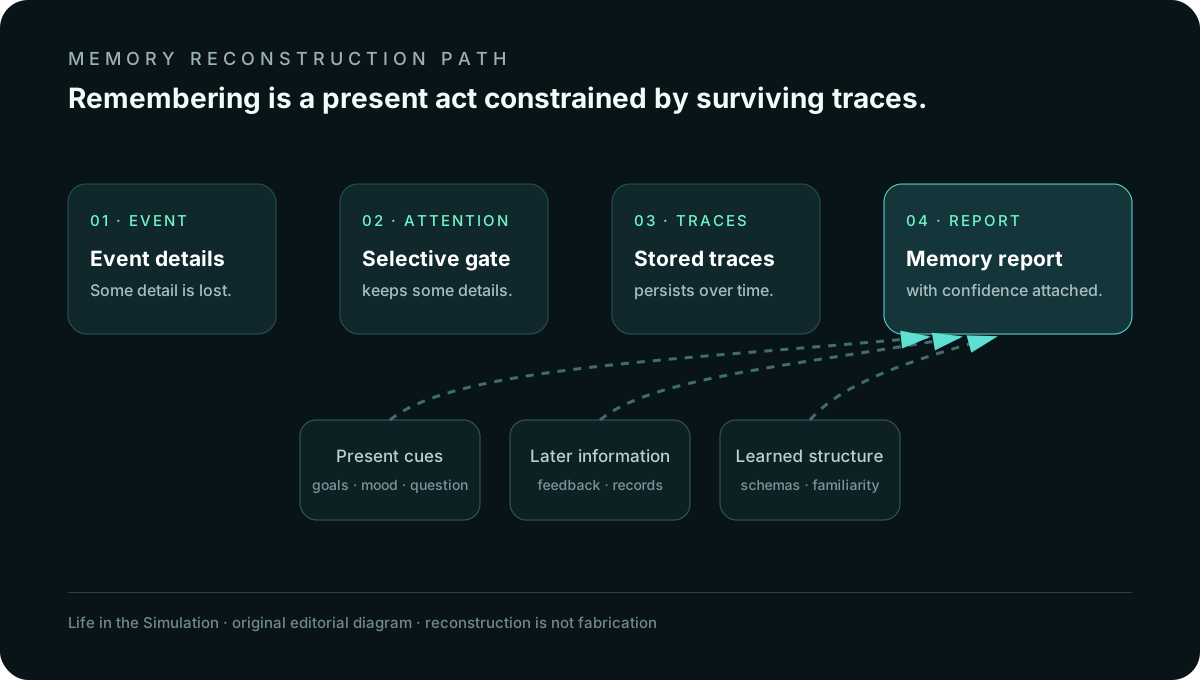
Human memory is better understood as a reconstruction: a present act built from incomplete traces, learned structure, current cues and later information. The word reconstruction is often heard as an accusation—someone invented the story, therefore the story is worthless. That conclusion is too crude. A weather model is reconstructed from measurements and still useful. A map omits detail and still guides. The question is not whether memory is perfect. The question is what kind of evidence a particular memory can carry.
Retrieval is a new event
When a person remembers, the brain does not simply expose an untouched object. Retrieval occurs in a new context, with new goals and new information available. The remembered event is assembled well enough to support recognition, prediction, identity and action. Details that were never encoded cannot be recovered. Details that were encoded may be inaccessible. Knowledge about what normally happens can fill gaps without announcing itself as a guess.
This is not a defect pasted onto an otherwise ideal archive. Generalization is part of what makes memory useful. A system that stored every pixel but could not extract a pattern would be a terrible guide to the next room, conversation or danger.
A false detail can feel remembered
In the Deese–Roediger–McDermott laboratory paradigm, participants study lists of related words. A list might contain bed, rest, awake and tired while omitting the strongly associated word sleep. People sometimes later recall or recognize the missing associate. Roediger and McDermott's 1995 experiments showed that this error can be accompanied by a subjective experience of remembering, not merely a weak guess.
The result does not show that autobiographical memory is wholly fabricated. A controlled word-list effect is not every memory in miniature. It establishes a narrower and important point: familiarity, semantic fit and the feeling of recollection can converge on an item that was not presented.
Later information can enter the account
Memory reports can also change after feedback. In a study of witnesses to real crimes, Daniel Wright and Elin Skagerberg measured confidence and memory judgments before and after witnesses learned whether they had selected a suspect or a filler. Post-identification feedback affected later reports. This is why a clean procedure records a witness's confidence and description at the time of the first identification, before confirming information arrives.
The everyday version is less dramatic and more common. A family repeats one version of a holiday story. A photograph supplies a viewpoint that becomes difficult to distinguish from direct experience. A message thread supplies the wording everyone later believes they heard. None of this requires deception. Rehearsal can stabilize a narrative while blurring the route by which each detail entered it.
Confidence is not meaningless—but timing matters
“Confidence never predicts accuracy” has become its own certainty theater. Research on eyewitness identification is more conditional. John Wixted and colleagues reviewed evidence that confidence recorded immediately after a properly administered first identification can be strongly informative. Confidence expressed later—after repeated questioning, feedback or exposure to other accounts—answers a different evidentiary question.
The practical lesson is not to trust confidence or distrust it categorically. Ask when it was measured, what procedure produced it, whether the person chose freely, what feedback occurred and whether the memory has been retold. A number without a procedure is a thin fact.
External records are not neutral replay either
Photographs, messages, calendars and video can correct memory. They can also narrow it. A camera records one angle. A message records what was typed, not tone or everything that was left unsaid. A calendar records intention more reliably than completion. An AI-generated meeting summary may compress a discussion into claims nobody made in exactly that form.
Use records as independent constraints, not as magical access to the whole past. Check timestamps, authorship, edits, missing intervals and whether the record was created before or after the disagreement. The reality audit is useful here because it separates the event, the record, the interpretation and the story now being told.
Synthetic summaries create a new contamination path
AI systems can turn calls, photographs and message archives into fluent retrospective narratives. The convenience is real. The summary can also become the version everyone rehearses. If a model merges two speakers, infers an intention or supplies a plausible bridge, the error may later feel familiar because the polished summary was reread.
No cited memory experiment directly tests every current AI-summary workflow. The inference is procedural: when a generated account may influence later recollection, keep the original material, label the summary as generated and correct it before it becomes the shared archive. Fluency should not erase provenance.
A protocol for memory disagreement
- Freeze independent first accounts. Each person writes what they remember before discussing details. Preserve the timestamp.
- Separate observation from inference. “I saw the door open” is different from “he intended to leave.” Mark the second as interpretation.
- Name the confidence and its age. Record confidence now, while noting how many retellings, photographs or conversations have occurred.
- Preserve source order. Identify which records existed before the memory report and which appeared afterward.
- Look for independent constraints. Timestamps, receipts, location records and uninvolved witnesses can narrow the possibilities. Verify their limitations.
- Do not treat discrepancy as proof of lying. Deception is one explanation among many. Attention, vantage point, elapsed time and reconstruction can also diverge.
- Stop where the evidence stops. “We disagree and cannot resolve this detail” is a valid conclusion.
This protocol is for ordinary disagreements and personal calibration, not a substitute for qualified legal, clinical or forensic practice. High-stakes interviews require trained procedures.
What the evidence supports—and what it does not
Sourced fact
People can remember related material that was not presented; post-event feedback can influence later memory reports; and the information carried by confidence depends on when and how it is collected.
Open disagreement
Researchers continue to debate how laboratory findings generalize across autobiographical, eyewitness and emotionally significant memories, and which confidence conditions are most diagnostic.
Reasonable inference
First accounts and original records should be preserved before collaborative retelling or synthetic summarization changes the evidence environment.
Speculation
As generated summaries become ordinary, people may increasingly remember the compressed account rather than the source material. The mechanism is plausible; the scale is not established.
Fallibility is not futility
If memory were useless, no organism could learn a route, recognize a face, maintain a relationship or avoid a repeated mistake. Its failures matter precisely because its successes are so structurally important. The responsible stance is neither “I remember it, therefore it happened exactly this way” nor “memory is unreliable, therefore nothing can be known.”
Memory is evidence with conditions. Ask how the trace was formed, what happened between event and report, which records can constrain it and how much confidence the procedure deserves. Epistemic humility is not amnesia. It is remembering with the joints exposed.
Sources and boundary
- Roediger, H. L. & McDermott, K. B. (1995), Creating false memories: Remembering words not presented in lists.
- Wright, D. B. & Skagerberg, E. M. (2007), Postidentification feedback affects real eyewitnesses.
- Wixted, J. T. et al. (2015), Initial eyewitness confidence reliably predicts eyewitness identification accuracy.
- National Research Council (2014), Identifying the Culprit: Assessing Eyewitness Identification.
This essay summarizes experimental and applied memory research. It does not assess the truth of any specific testimony, recovered memory or disputed event.
END OF TRANSMISSION 024
Keep the question. Test the model.
Choose the narrowest claim the evidence can carry, then leave room for revision.