A graph begins to slope before a person reports deciding to move. The finding is strange, durable and easy to overstate. It has been presented as a laboratory demolition of free will: the brain decides first, consciousness learns about it later, and the feeling of authorship is a story pasted onto machinery already in motion.
That conclusion is larger than the experiment. Neuroscience can measure preparation, prediction, inhibition and reported awareness. It can reveal conditions under which control weakens. It does not inherit a settled definition of “free will,” and a button press made at an arbitrary moment is not a complete model of choosing a career, keeping a promise or resisting an impulse.
What Libet and colleagues measured
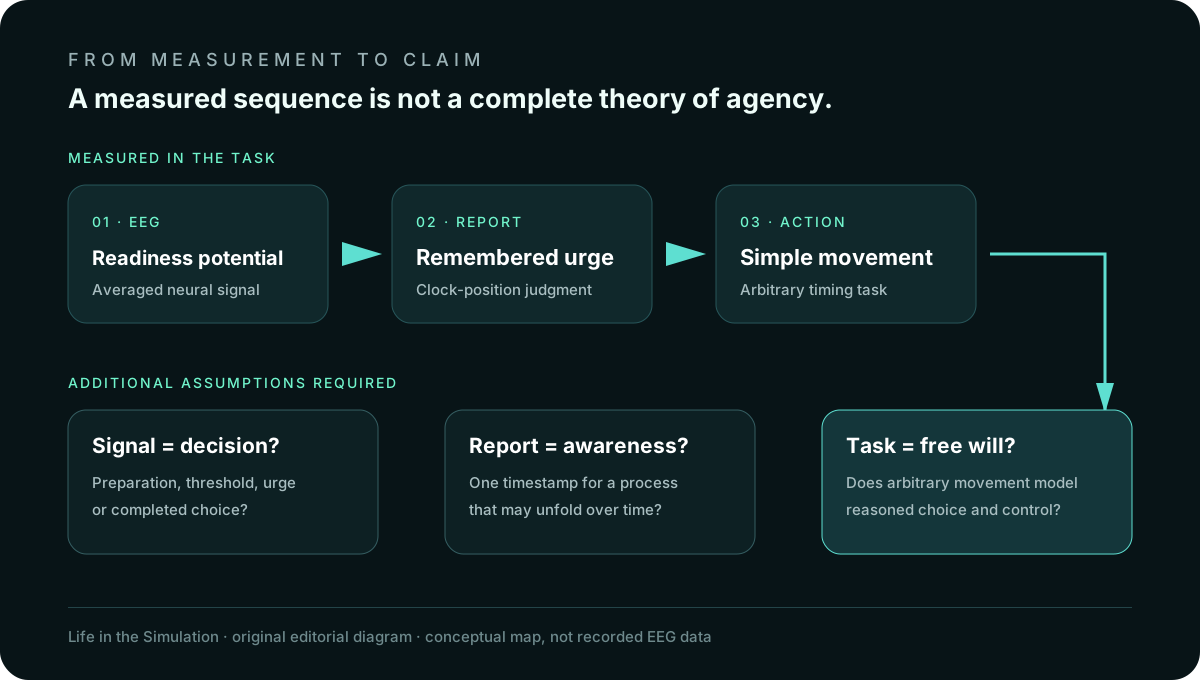
In the 1983 experiment associated with Benjamin Libet, participants watched a rapidly moving clock, flexed a wrist or finger whenever they felt like it and reported the clock position at which they first became aware of wanting to move. An electrical signal averaged across trials—the readiness potential—began several hundred milliseconds before the reported intention.
The temporal ordering matters: some movement-related brain activity preceded the reported moment of conscious intention. But each phrase carries a condition. The signal was produced by averaging many trials. The action was deliberately trivial. The intention time came from a retrospective visual report. “Brain activity preceded reportable awareness” is a result. “The unconscious brain completed the decision before the person entered the scene” is a theory of what the result means.
The brain is not somebody else
“Your brain decided before you did” treats the brain as an external agent competing with the person. That grammar is convenient and often misleading. Whatever human agency is, it is implemented through biological processes. Evidence that a decision has neural precursors is expected under nearly every naturalistic account of action.
The substantive question is not whether the brain was involved before awareness. It is what kind of process the early activity reflects: a settled choice, general preparation, accumulating noise, an urge, attention to timing or some mixture. Locating a precursor does not yet identify the unit that deserves to be called the decision.
A readiness potential may not be a hidden verdict
Aaron Schurger and colleagues modeled spontaneous movements as threshold crossings in ongoing neural activity. On that account, averaging trials backward from movement can produce a ramp-shaped readiness potential even if each trial does not contain a long, deterministic preparation toward one inevitable action. The model does not restore a metaphysical soul. It changes what the early signal may signify.
A 2021 meta-analysis found that the overall timing pattern was broadly consistent with Libet, while emphasizing that the most philosophically important comparison rested on only a small number of studies and carried substantial uncertainty. Replication of a waveform is not automatically replication of the most expansive interpretation.
Reported intention is a difficult timestamp
The participant must act, notice an urge, attend to a clock and later report a position. Those processes have different delays. Work examining the method has argued that the reported intention time can be influenced by task experience and inference. This does not make introspection useless. It makes a single subjective timestamp a noisy boundary for a process that may unfold over time.
Conscious access is not necessarily an internal notification that appears at one exact millisecond. Reasons, attention, restraint and goal maintenance can shape an action before a person can isolate a clock position for “when I decided.”
Arbitrary movement is not deliberation in miniature
Uri Maoz and colleagues compared arbitrary choices with deliberate decisions involving meaningful consequences for nonprofit donations. They reported a readiness potential for arbitrary decisions but not the same pattern for deliberate choices. One experiment does not prove two wholly separate kinds of agency, yet it blocks a casual generalization from purposeless timing tasks to decisions that integrate reasons and values.
A person can choose through a policy built over years. Avoiding cigarettes, returning money or keeping a medical appointment may depend less on a last-millisecond conscious command than on habits, environments and commitments arranged in advance. If agency is a capacity to respond to reasons and govern behavior across time, the instantaneous urge is only one layer.
Prediction is not inevitability
Some studies can classify an upcoming simple choice above chance from earlier brain activity. Above chance is not certainty. A probabilistic signal can constrain a theory without proving that the future was fixed in the way a philosophical argument requires. Prediction accuracy, alternative possibilities and causal explanation are different questions.
The same caution applies in reverse. Unpredictability is not freedom. Random noise does not become authorship merely because an observer cannot forecast it. A serious account of agency needs control, reasons, learning and the ability to revise—not a gap in measurement.
Three questions that should not be collapsed
- Mechanism: Which neural processes prepare, select, inhibit and execute an action? Neuroscience directly investigates this.
- Capacity: Can a person understand reasons, anticipate consequences, regulate impulses and adapt? Neuroscience and psychology can measure parts of this under defined conditions.
- Metaphysics: Could the person have done otherwise in exactly the same total state of the universe? An EEG timing task does not settle this alone.
Arguments about free will often fail because one answer is smuggled into another level. A mechanistic account does not automatically erase the capacity it explains, just as describing memory biologically does not make remembering unreal.
What the science changes in ordinary life
The research weakens the picture of a tiny conscious executive issuing every command from outside causality. It strengthens a distributed picture: action emerges from processes with different time scales, many outside immediate awareness. That is not permission to stop designing for agency. It is a reason to design more intelligently.
- Move control earlier. Use defaults, environments and written commitments before the high-pressure moment. The decision journal preserves reasons before outcomes revise them.
- Protect inhibition. Sleep, intoxication, stress and coercion change the capacities that make self-control possible.
- Judge the whole process. Ask whether the action reflects stable reasons, available alternatives and an ability to learn—not whether a conscious sentence appeared first.
- Keep accountability proportional. Explanation can reveal constraints without forcing either total blame or total exoneration.
What is established, disputed and open
Sourced fact
Readiness-related brain activity can precede reported awareness of an urge in simple self-timed movement tasks.
Expert disagreement
Researchers dispute what the early signal represents, how valid the intention timestamp is and how far arbitrary motor tasks generalize to deliberate choice.
Reasonable inference
Human control is better studied as a multi-stage capacity distributed across preparation, awareness, inhibition and long-term policy than as one magical instant.
Speculation
Future measurement may predict increasingly complex choices. Prediction alone still would not decide which philosophical definition of freedom is correct.
Sources and boundary
- Libet, B. et al. (1983), Time of conscious intention to act in relation to onset of cerebral activity.
- Schurger, A., Sitt, J. D. & Dehaene, S. (2012), An accumulator model for spontaneous neural activity prior to self-initiated movement.
- Maoz, U. et al. (2019), Neural precursors of decisions that matter.
- Braun, M. N., Wessler, J. & Friese, M. (2021), A meta-analysis of Libet-style experiments.
This essay evaluates what a family of laboratory tasks can support. It does not claim to solve free will, moral responsibility or consciousness, and it does not treat neurological or psychiatric impairment as a philosophical verdict on a person.
END OF TRANSMISSION 025
Keep the question. Test the model.
Choose the narrowest claim the evidence can carry, then leave room for revision.