A claim with ten citations can rest on one observation. One paper reports a result. A review summarizes it. A policy brief cites the review. A news story cites the brief. Five blogs cite the story. The final page now has a respectable wall of links, but the evidence has not multiplied. It has traveled.
This is not a reason to distrust every review, summary or later paper. Synthesis is necessary. It is a reason to distinguish documents from independent evidence. Counting links answers how often a claim was repeated. It does not answer how many separate observations, methods or datasets support it.
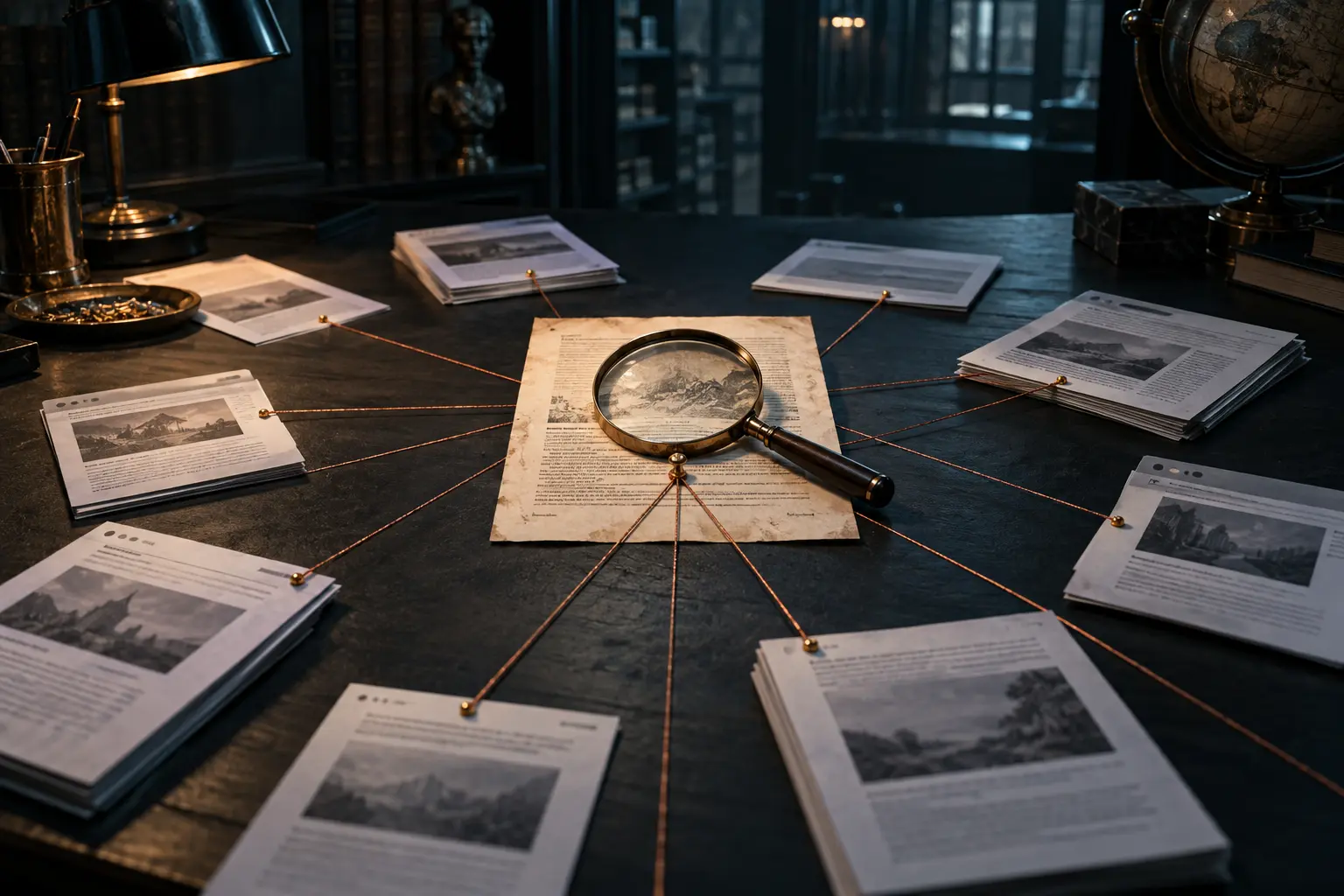
How a citation cascade manufactures certainty
A citation cascade begins when a claim moves farther from its origin while its language becomes cleaner and more confident. The original may say a result was observed in a small sample under narrow conditions. The next source says the study “suggests” a broader effect. A later summary drops the qualifier. By the time the claim reaches a presentation, it is introduced as something “research shows.”
Each writer may be acting in good faith. The distortion can emerge from compression. Reviews cannot reproduce every caveat. Headlines require short sentences. Product pages prefer conclusions to methods. AI systems are rewarded for fluent answers. But every compression removes context, and removed context often includes the boundary that kept the claim honest.
Steven Greenberg's 2009 analysis in The BMJ traced how claims about a medical hypothesis moved through a citation network. The paper documented selective citation, amplification and citation distortion in that specific case. It does not prove every literature behaves the same way. It demonstrates a mechanism: a network can make a belief look independently established even when later documents inherit the same evidential ancestry.
Documents are not evidence units
A document is a container. It may hold original data, a new analysis, an editorial judgment, a review of earlier work or nothing beyond another citation. Two documents can therefore contribute very different evidential value.
A second laboratory repeating a procedure with new participants adds evidence. A meta-analysis may add value by estimating an overall effect and testing variation, but it does not turn the included studies into more studies. A commentary that cites the meta-analysis adds interpretation, not another observation. A retailer copying a manufacturer's specification adds distribution, not verification.
The distinction is especially important when apparent agreement is generated by a shared upstream dependency. Ten forecasts using the same underlying dataset are not ten independent looks at reality. Five experts relying on the same unpublished briefing are not five independent sources. Three AI answers generated from the same commonly indexed articles may feel like consensus while sharing both evidence and blind spots.
Build a source-provenance map
You do not need specialized software. Start with the consequential claim and draw arrows backward.
- Write the exact claim. Make it narrow enough that the source could actually support or contradict it.
- List every cited document. Record title, date, author or institution, and whether you accessed the full source.
- Classify the contribution. Mark original observation, independent replication, reanalysis, synthesis, commentary, press material or repetition.
- Trace each factual assertion. When a review makes a claim, follow its citation to the underlying paper. Continue until you reach the observation or a dead end.
- Group shared ancestry. Put documents relying on the same dataset, experiment or report in one family.
- Mark transformations. Note where sample limits, uncertainty, conditional language or disagreement disappears.
- Count independent routes. Count distinct observations and methods, not boxes on the page.
This extends the site's AI citation verification protocol. Verifying that a paper exists is necessary. It is not enough. A real paper can be misquoted, a review can cite a review, and an accurate quotation can still be irrelevant to the claim being made.
The corroboration matrix
| What the new source adds | Independent evidence? | How to describe it |
|---|---|---|
| New participants, measurements and analysis | Usually, if genuinely separate | An independent study found a compatible result |
| Same data, different defensible analysis | No new observation; useful robustness check | A reanalysis tested whether the result survives another method |
| Review of several independent studies | Synthesis, not an extra study | A review summarized the available evidence |
| Press release based on one paper | No | The institution summarized its own study |
| News reports all quoting one expert | No | Several outlets repeated one interpretation |
| Separate method predicting a novel result | Potentially strong | An independent route converged on the claim |
| Manufacturer claim copied by retailers | No | Multiple listings repeat the manufacturer's specification |
The word “independent” deserves pressure. Two papers from different teams may share a database, measurement error or analytical convention. Two news reports may be written separately yet depend on the same interview. Independence is not a binary badge supplied by a different domain name. It is a claim about evidential ancestry.
Three common failure modes
Citation laundering
A weak or speculative claim enters a review and later sources cite the review rather than the original. The review's authority makes the claim appear stronger. To detect this, compare the later sentence with the language and design of the earliest accessible source.
Dead-end authority
A claim points to an institution, database or expert but not to the underlying record. Institutional reputation can justify attention; it cannot replace the missing evidence. If the decision matters, ask what observation the authority is relying on.
Consensus by search result
Search engines surface many pages containing the same phrase. Repetition can reflect syndication, optimization or common copying rather than independent agreement. Open the pages and trace their sources before treating result count as corroboration.
Replication is more than the same conclusion
The National Academies' report on reproducibility and replicability distinguishes obtaining consistent computational results from obtaining consistent findings in a new study. The terms are used differently across fields, so the safest practice is to state what actually happened: same data and code, new data with the same method, or a different method testing the same proposition.
Convergence becomes more informative when error sources differ. A survey, administrative record and physical measurement may all have limitations, but they are not necessarily vulnerable in the same way. Agreement across genuinely different routes can narrow the set of plausible explanations more than three nearly identical analyses can.
Why this matters for AI-assisted research
An AI answer can produce a long reference list without proving source independence. Models may select reviews, summaries and pages that all descend from one study. They may also attach a citation that is real but only tangentially related. Use an evidence ledger to record which source supports which claim, then add a provenance column: “What original observation does this depend on?”
Ask the system to identify primary sources, but verify the answer yourself. Ask for contrary evidence, but do not assume the generated list is complete. AI is useful for discovering candidates and organizing a map. It is not an independent witness to the facts in its training data.
A calibrated conclusion
After mapping, describe the evidence in a sentence that preserves its structure: “Seven articles discuss the claim, but six rely on the same study; one independent dataset reports a compatible result under different conditions.” That sentence is less dramatic than “many studies prove.” It is also much more useful.
The goal is not to reduce every literature to a number. It is to prevent the number of documents from impersonating the number of observations. A citation is a route to evidence, not evidence by decorative accumulation.
Sources and further reading
- Greenberg, “How citation distortions create unfounded authority”, a case study of belief amplification in a citation network.
- National Academies: Reproducibility and Replicability in Science, for definitions, field differences and recommendations.
- Life in the Simulation: separate claim, evidence and inference, for the companion reasoning worksheet.
END OF TRANSMISSION 045
Keep the question. Test the model.
Choose the narrowest claim the evidence can carry, then leave room for revision.