There is a small, treacherous pleasure in reading an explanation that clicks. The sentences are clean. The analogy lands. The answer feels obvious in retrospect. Then somebody asks you to explain the mechanism without the source in front of you, predict what happens when one condition changes, or apply the idea to a new case. The clarity evaporates.
That failure is not unusual, and it is not a character flaw. It is a mismatch between two things the mind often treats as one: the feeling that material is easy to process and the possession of a model that can survive a test.
Two claims that should not be merged
The first claim is empirical: people can substantially overestimate how well they understand ordinary mechanisms. In a classic series of experiments, Leonid Rozenblit and Frank Keil asked people to rate their understanding of devices and natural phenomena, explain them in detail, and then rate their understanding again. The attempt to explain exposed gaps. The researchers called the pattern the illusion of explanatory depth.
The second claim is practical: a strong explanation should change what you can do. It should let you identify the important variables, trace a causal chain, make a bounded prediction, notice an exception and update when the world pushes back. That standard is stricter than feeling convinced, but it is also kinder. It replaces shame about not knowing with a procedure for finding the edge of what you know.
These claims do not imply that every subject must be reconstructed from first principles. Civilization works because knowledge is distributed across people, tools and institutions. The point is calibration: knowing which parts live in your head, which parts live in the environment and which parts are still missing.
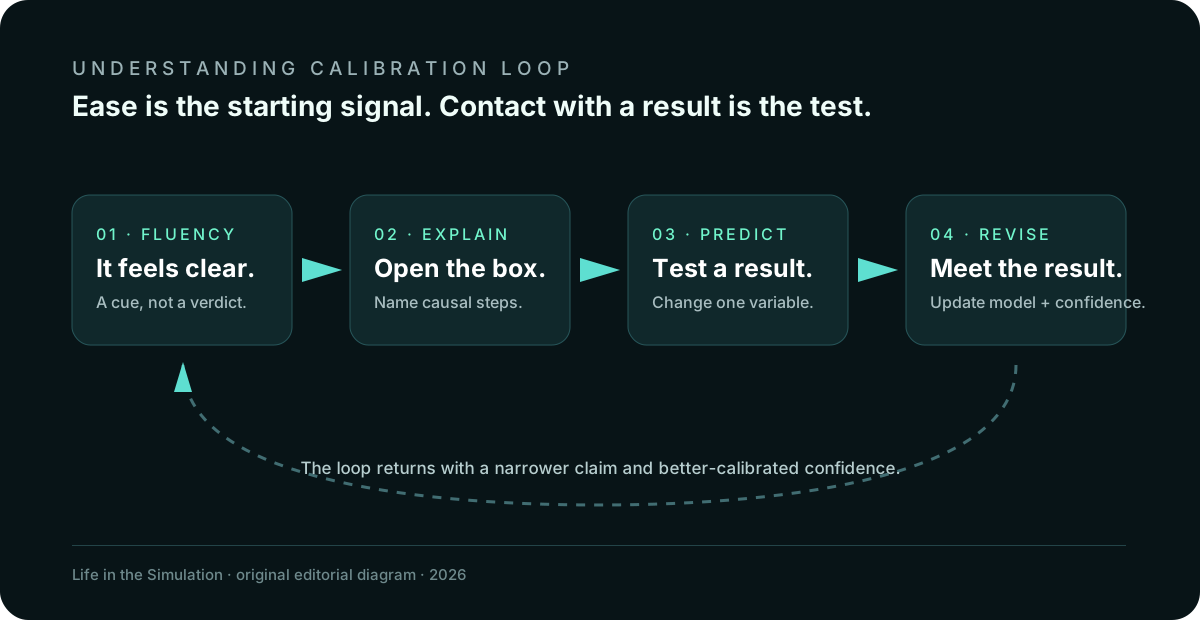
Fluency is a cue, not a verdict
Psychologists use processing fluency for the subjective ease with which information is processed. A broad review by Adam Alter and Daniel Oppenheimer describes how fluency can influence judgments about truth, familiarity, risk and preference. Clear wording and a familiar frame can be genuinely helpful. They reduce friction and free working memory. But the feeling of ease is ambiguous: it may come from good structure, repetition, prior exposure, a confident speaker or a conclusion you already wanted.
That ambiguity matters online. Interfaces reward the answer that arrives quickly, reads smoothly and closes the tab. Search snippets, explainers and AI summaries can all compress the visible labor behind a conclusion. Compression is useful. It can also conceal assumptions, uncertainty and missing steps.
This does not establish that summaries or AI systems necessarily damage learning. Outcomes depend on the task, the reader and how the tool is used. The narrower inference is enough: when fluent answers become abundant, fluency becomes a less discriminating signal of understanding.
Recognition is not recall; recall is not transfer
With notes open, the vocabulary looks familiar. In a multiple-choice list, the right answer stands out. Neither condition resembles the moment when the knowledge must be produced without prompts. Aslan Koriat and Robert Bjork showed how study conditions can give people cues that will not be available at test, producing illusions of competence.
There are at least four increasingly demanding tests:
- Recognition: can you identify the idea when it appears?
- Recall: can you produce its important parts without the source?
- Prediction: can you say what should happen before you see the result?
- Transfer: can you use the model in a case with different surface details?
A reader may pass one level and fail the next. That is useful information, not humiliation. “I recognize this” is a valid status. It is simply not the same status as “I can use this.”
AI changes the supply of explanations, not the standard
An AI system can generate a coherent account in seconds. Sometimes the account is accurate and useful. Sometimes it is a polished arrangement of incorrect premises. More subtly, the account may be correct while the reader remains unable to reproduce or apply it. The output’s quality and the user’s understanding are separate variables.
This distinction parallels the difference between a model being right and a model understanding why, but the object of evaluation is different. There we test the system. Here we test ourselves. Quoting a correct answer does not transfer its causal structure into the person quoting it.
A good use of AI is therefore adversarial in the mild, scientific sense. Ask for assumptions. Request a counterexample. Make your own prediction before requesting the answer. Compare the response with a primary source. Ask the system to challenge your explanation, then verify the challenge rather than accepting it automatically.
The explanation stress test
Use this protocol on one consequential concept: a policy you support, a health claim you are discussing with a professional, a financial mechanism, a technical architecture or an AI capability. Do not begin with your entire worldview.
- State the question narrowly. “How does a heat pump move heat in cold weather?” is testable. “Do heat pumps work?” hides the mechanism and conditions.
- Rate confidence before looking anything up. Use a range, not a theatrical point estimate: “I am 60–75% confident I can explain the causal chain.”
- Explain from memory. Write five to ten sentences. No tabs, notes or assistant. Draw arrows if the process has stages.
- Circle labels pretending to be explanations. Words such as “algorithm,” “incentive,” “efficiency,” “energy” and “the market” often name a box without opening it.
- Make one prediction. Change a variable. What should increase, decrease or fail? Record the answer before checking.
- Consult a strong source. Prefer original research, official documentation or a serious textbook. Mark what was wrong, absent or too confident.
- Revise both model and confidence. The goal is not to restore the original number. It is to leave with a narrower, more useful claim.
This works well beside a decision journal. The dated prediction protects against hindsight. A weekly reality audit can then ask whether the model improved any decision or merely decorated your vocabulary.
The environment knows more than you do
Much apparent understanding is borrowed from reliable access. You know where the manual is, which colleague to ask, which search query works or which tool will calculate the result. That is not fake knowledge. It is a form of distributed competence. The mistake is forgetting the distribution and claiming all of it as internal mastery.
The distinction becomes visible when access disappears. Could you detect a bad answer? Could you recover the chain from first principles? Could you name the authority on which the claim depends? Our habit of searching before wondering is not wrong because external memory is impure. It is risky when retrieval replaces the pause in which a testable model would have formed.
What the evidence supports—and what it does not
Sourced fact
People can overrate their understanding of mechanisms, and judgments of learning can rely on cues that will not be available at test. Processing fluency influences multiple judgments.
Open disagreement
Researchers disagree about how metacognitive cues interact across tasks and about which interventions transfer reliably outside controlled settings.
Reasonable inference
Because modern systems produce fluent explanations cheaply, readers should rely more heavily on recall, prediction and transfer when a claim matters.
Speculation
A culture saturated with synthetic explanations may become more articulate while becoming less calibrated. That is plausible, not established.
Certainty theater scales
Organizations reward visible fluency: the smooth briefing, the confident roadmap, the deck without unresolved arrows. Acknowledging the missing mechanism can feel like weakness even when it is the most accurate contribution in the room. The result is certainty theater—confidence optimized for social acceptance rather than contact with the system.
A healthier review asks four questions: What is the mechanism? What would we expect if it were true? What result would lower our confidence? Where is the source of record? These questions do not eliminate uncertainty. They make uncertainty legible enough to manage.
A smaller daily practice
Once a day, pause after an explanation that feels especially satisfying. Close it. Write the causal chain in three lines. Make one prediction. Reopen the source and compare. Most ideas do not deserve this treatment; important ones do.
Understanding is not a mood awarded by elegant prose. It is a model with exposed joints—a model that can be questioned, used, surprised and repaired.
Sources and boundary
- Rozenblit, L. & Keil, F. (2002), The misunderstood limits of folk science: an illusion of explanatory depth.
- Alter, A. & Oppenheimer, D. (2009), Uniting the Tribes of Fluency to Form a Metacognitive Nation.
- Koriat, A. & Bjork, R. (2005), Illusions of competence in monitoring one's knowledge during study.
This essay applies findings from cognitive psychology to a modern information environment. The application to AI-mediated explanation is editorial inference, not a claim that the cited studies tested current AI systems.
END OF TRANSMISSION 023
Keep the question. Test the model.
Choose the narrowest claim the evidence can carry, then leave room for revision.