You wake from a dream that had streets, weather, other people and a history that seemed to exist before you arrived. For a few seconds, the waking room feels like the second world. The experience is philosophically useful. It is not a diagnostic message from outside reality.
The tempting argument is simple: if a sleeping brain can generate a convincing world, perhaps ordinary life is also generated by a larger system. The first half is an observation about experience. The second is a hypothesis about the substrate of the universe. The distance between them is where most of the work has been skipped.
What dreams actually establish
Dreaming is not confined to rapid-eye-movement sleep. In a high-density EEG study, researchers obtained reports of dream experience after awakenings from both REM and non-REM sleep and associated reported experience with patterns in posterior cortical activity. A later review describes REM dreams as tending to be longer, more vivid and more story-like than non-REM dreams while noting that the physiological function of dreaming remains unsettled.
Those findings support a narrow but consequential point: a person can have organized experience while sensory contact with the waking environment is reduced and behavior is largely suspended. The brain participates in constructing the experienced scene. Perception is not a transparent window through which the world simply pours.
None of that identifies the ultimate material of the waking universe. A mechanism inside the world can explain why a dream feels real without showing that the world itself is another dream, a computer program or an illusion. A planetarium proves that projected stars can look convincing. It does not prove that the night sky is projected.
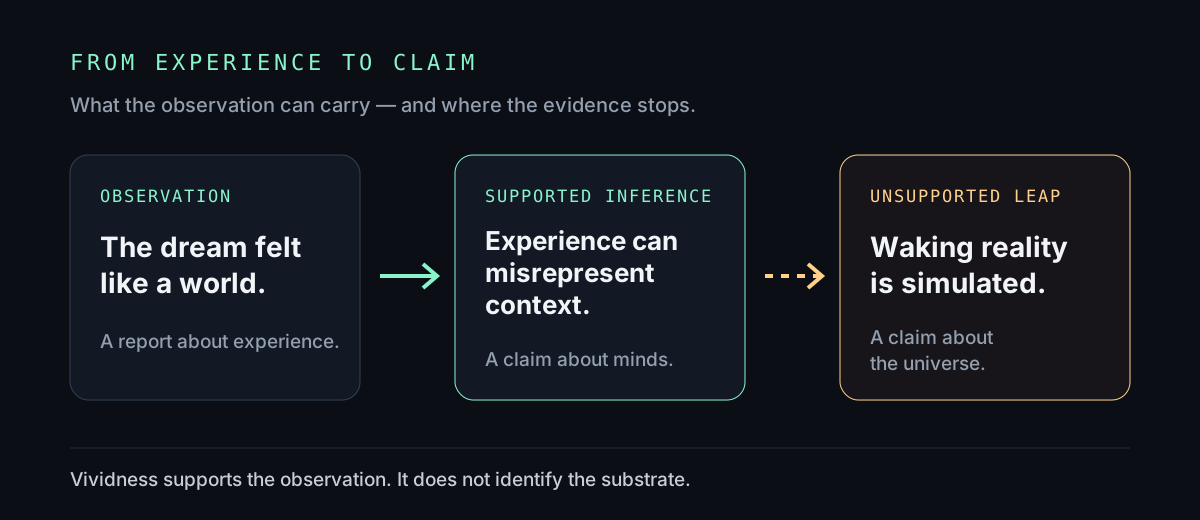
Vividness is not a truth detector
Certainty can be part of a mental state. It is not automatically a property of the proposition inside that state. Dreams make this visible because the confidence sometimes collapses upon waking. The remembered conviction was real; the dreamed situation was not occurring as represented.
The same distinction matters while awake. Déjà vu, a striking coincidence, sleep paralysis or a lucid dream can feel charged with explanation. The intensity may justify curiosity, rest or clinical attention. It does not assign a cosmic cause. Treating emotional force as external verification is exactly the category error a reality audit is designed to catch.
This does not make experience worthless. First-person reports are indispensable evidence for studying consciousness. They are simply evidence of a particular kind: reports from a subject about what appeared. Moving from appearance to an external cause requires corroboration, competing explanations and predictions that could fail.
An analogy can clarify without confirming
Dreaming is a productive analogy for simulation because both scenarios separate an experienced environment from whatever generates it. The analogy helps formulate questions: How would an inhabitant distinguish levels? Which observations survive a change of substrate? Does an experience need to reveal its implementation in order to be meaningful?
But an analogy is not a measurement. A hurricane can be described as a heat engine; that does not make it a machine built in a factory. The brain can be described as predictive; that does not establish that perception is literally a rendered computer display. Similar structure does not imply identical cause.
The site's plain-language account of the simulation hypothesis makes the same distinction. Nick Bostrom's 2003 simulation argument is a conditional population argument built from assumptions about future civilizations, conscious simulations and observer selection. It is not an argument from dreams, glitches, coincidences or the feeling that reality is strange.
Ask whether the observation discriminates
Evidence does useful work when it is more expected under one explanation than under its rivals. Let D be the observation “humans sometimes have vivid dreams.” Compare two broad hypotheses:
- H1: waking reality is a computer simulation capable of containing sleeping human brains.
- H2: waking reality is not such a simulation, but contains sleeping human brains.
If ordinary neurobiology predicts dreams under both hypotheses, then observing a dream does little to choose between them. It fits both stories. Calling it “simulation evidence” without showing why it is substantially more likely under H1 than H2 merely gives the observation a dramatic label.
This is why a strange event can be compatible with a theory without confirming it. Almost any event can be made compatible with a sufficiently flexible simulation story: the operators wanted it, the rendering failed, the memory was edited. A theory that absorbs every possible result has stopped taking evidential risk. Read What Would Count as Evidence? for the stricter standard.
Lucid dreaming is not administrator access
In a lucid dream, a sleeper becomes aware of dreaming and may gain some control over the scene. That is fascinating because metacognition can appear within an ongoing dream. It still does not follow that waking awareness can grant control over external physics, expose source code or contact an operator.
The relevant boundary is mundane: dream control is reported within a state generated by the sleeping brain. Waking claims concern shared, repeatable events among observers who can compare instruments and records. A private experience becomes public evidence only through a method that lets other people check something beyond the report itself.
Keep four boxes separate
Dream reports occur after awakenings from REM and non-REM sleep, and measurable neural activity varies with reported dream experience.
Researchers continue to debate the mechanisms and functions of dreams, including their roles in memory and emotion.
Dreams weaken naive confidence that vivid experience must accurately represent the immediate environment.
Dreaming may be a useful model for thinking about constructed experience. It does not identify waking reality's substrate.
A protocol for a reality-charged dream
- 01 / RECORDWrite the experience before interpreting it.
Separate what you remember seeing, hearing and feeling from the explanation that arrived afterward. Dream memory changes quickly.
- 02 / LABELName the claim precisely.
“The dream felt unusually coherent” is different from “the dream predicted an event” and radically different from “reality is simulated.”
- 03 / PREDICTState what should happen next.
A claim that cannot say what would count against it is not ready to carry belief. Time-stamp specific predictions before checking outcomes.
- 04 / COMPARECount misses and ordinary explanations.
Do not preserve one resemblance while discarding dozens of dreams that predicted nothing. Check sleep disruption, recent inputs and coincidence before cosmic causes.
- 05 / GROUNDReturn to shared reality.
Eat, sleep, walk, talk with somebody you trust and use ordinary records. If experiences are frightening, persistent or disrupting daily life, seek qualified professional support rather than building a metaphysical system around them.
The protocol does not explain away wonder. It protects wonder from being conscripted into certainty. The hard problem of consciousness remains strange even when a particular argument fails.
Sources and boundaries
- Siclari et al., “The neural correlates of dreaming”, Nature Neuroscience (2017). Used for REM/NREM dream reports and associated EEG findings.
- Murkar and De Koninck, “What are the neural mechanisms and physiological functions of dreams?”, Neuroscience Research (2023). Used for the current review-level account and open questions.
- Bostrom, “Are You Living in a Computer Simulation?”, author-hosted copy of the Philosophical Quarterly paper (2003). Used to distinguish the published simulation argument from a dream analogy.
Boundary note: This essay evaluates an argument. It does not diagnose sleep experiences, settle the nature of consciousness or claim to disprove every possible simulation hypothesis.
END OF TRANSMISSION 022
Keep the question. Test the model.
Choose the narrowest claim the evidence can carry, then leave room for revision.