The word observer carries too much ordinary-language baggage into quantum mechanics. Outside physics, an observer is usually a conscious witness: someone who sees, notices and knows. Inside a laboratory, observation can be a photodiode registering a photon, an atom becoming correlated with another system or a durable mark appearing in an instrument. No person has to stare at the event while it happens.
That distinction matters because a popular argument often moves in three quick steps: measurement changes a quantum experiment; measurement is called observation; therefore consciousness creates physical reality. The first statement can be experimentally grounded. The second is technical vocabulary. The third does not follow without substantial additional premises and evidence.
Start by separating three meanings
Measurement back-action is the broad fact that learning about a physical system often requires an interaction, and that interaction can affect what is measured. This is not uniquely quantum. A tire gauge releases a little air; a thermometer exchanges heat. Quantum theory adds distinctive constraints because some quantities and experimental arrangements cannot be treated as revealing pre-existing classical properties in the same simple way.
Loss of interference is what many famous demonstrations actually show. In a two-path experiment, an interference pattern can appear when alternatives remain coherent. A device that makes path information physically available can entangle the particle with the apparatus or environment. The alternatives no longer combine in the same observable way for the subsystem.
The measurement problem is deeper. Quantum dynamics permits superpositions, yet experiments deliver particular records. Physicists and philosophers disagree about how to understand that transition, or whether the demand for a transition is itself a mistake. Decoherence explains why interference between alternatives becomes inaccessible under environmental interaction and why stable, classical-looking records emerge. It does not, by itself, select one interpretation of quantum mechanics.
A detector does not need an audience
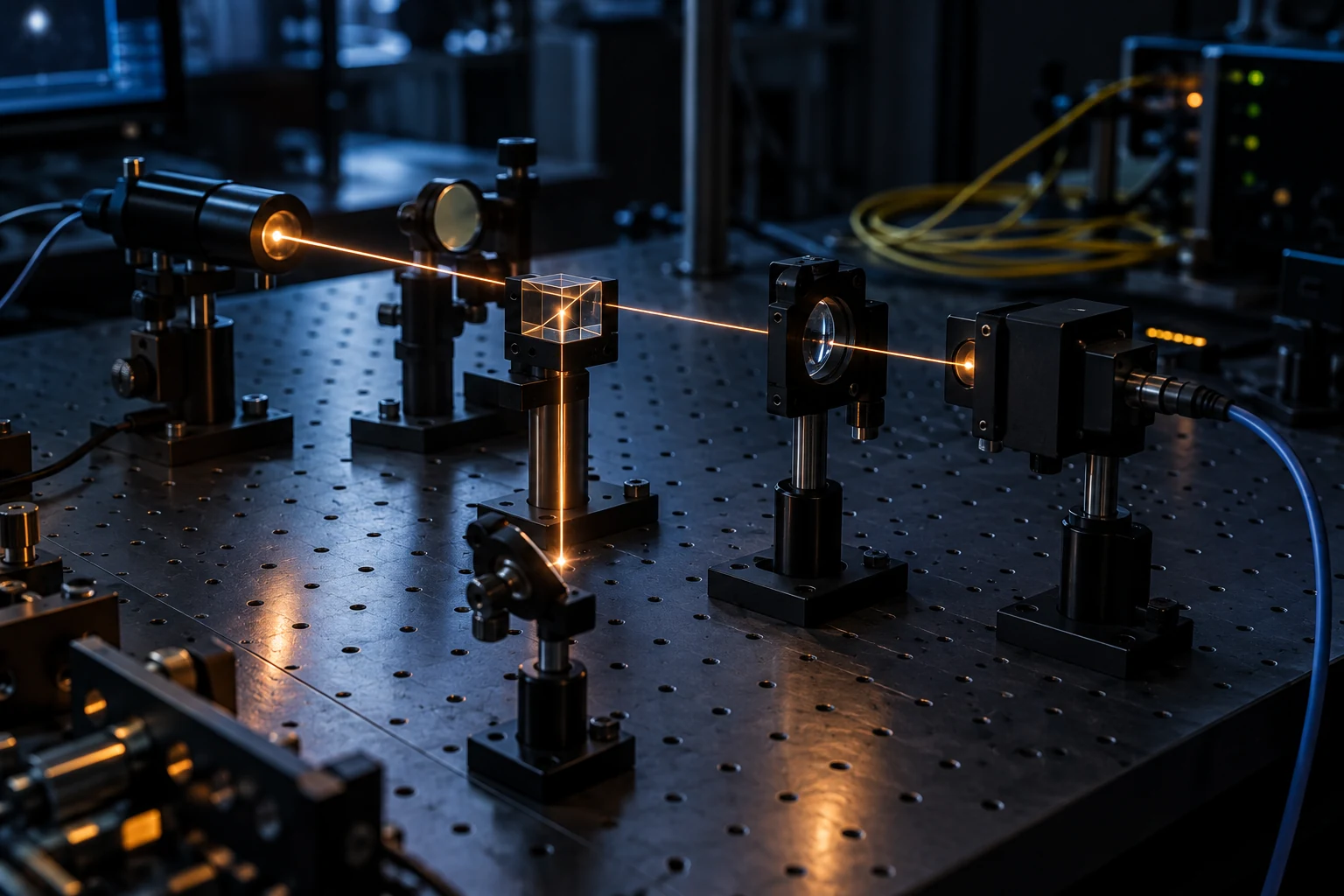
Imagine a detector connected to a storage device in a sealed laboratory. It registers an event at noon. The file is opened the next morning. Standard quantum calculations do not wait overnight for a person to become aware of the result. The physical interaction, amplification and record occurred at noon.
This does not settle every philosophical question about measurement. It does show why ordinary experimental talk of an “observer” should not automatically be translated into “human consciousness.” In modern accounts, the relevant boundary may involve a measuring apparatus, an environment, an information-bearing interaction or relations among physical systems. Which description is fundamental depends on the interpretation. None of those possibilities is established merely by noticing that physicists use the word observer.
What the double-slit experiment supports
In the familiar two-slit setup, individual quantum objects can accumulate an interference pattern when the alternatives remain coherent. When the apparatus obtains usable which-path information, that interference can disappear. The important variable is not whether a human looks at the data. It is whether the experimental arrangement creates distinguishable physical records of the alternatives.
“Watching changes reality” is therefore too loose. Changing the apparatus changes the physical conditions. The detector participates in the experiment. It is not a transparent window through which consciousness peeks at an otherwise untouched object.
A delayed human decision to inspect or discard an already recorded file cannot be substituted for the interaction that produced the record. Eraser-style experiments can recover interference in carefully selected correlations when path information is made unavailable, but they do not enable a later mind to rewrite an already observed past or send information backward in time.
What decoherence explains—and what it does not
Real systems do not remain isolated. They interact with air, radiation, instruments and countless degrees of freedom in the surrounding environment. Those interactions rapidly spread phase relationships into correlations that are practically inaccessible. The local system then behaves as though alternatives have lost the ability to interfere.
Decoherence is a major part of explaining why macroscopic objects look classical and why some records are stable. Wojciech Zurek’s review describes how environment-induced selection privileges robust states and classical correlations. The Stanford Encyclopedia of Philosophy emphasizes the boundary: decoherence suppresses observable interference, but it does not independently tell us why one definite outcome is experienced or which interpretation is correct.
That is an example of useful intellectual restraint. “Decoherence solves everything” is too strong. “Without consciousness, nothing becomes real” is also too strong. The evidence supports a detailed physical account of how systems, apparatus and environments become correlated. The remaining interpretive work should be named rather than filled with a preferred metaphysics.
Interpretations are not interchangeable with results
Copenhagen-style approaches, many-worlds views, Bohmian mechanics, objective-collapse theories, relational accounts and other interpretations organize the formalism differently. They disagree about what the quantum state represents, whether collapse is fundamental, whether all branches persist, or whether properties are relational. Some historical proposals gave consciousness a special role. That history does not turn consciousness-induced collapse into an experimental finding.
When interpretations make the same predictions for an experiment, the observed result cannot choose among them. A philosophical preference may be coherent or fruitful, but it should be labeled as interpretation. To claim empirical support, a proposal needs a prediction that differs from alternatives and a result capable of discriminating among them.
This is the same discipline used in What Counts as Evidence for a Simulated Reality?: begin with the competing claims, identify what each predicts and ask which observation would be more likely under one than another.
Consciousness remains a problem without becoming a measurement device
Nothing here makes consciousness trivial. As Consciousness Is Still the Weird Part argues, science can map relationships between brain activity, behavior and reports while the existence and character of subjective experience remain philosophically difficult.
But one hard problem does not solve another. Invoking consciousness at the measurement boundary does not explain how experience arises, why a particular physical process should possess the relevant awareness or how the proposal differs experimentally from a detector-and-environment account. It can connect two mysteries linguistically while leaving both mechanisms unspecified.
Likewise, the fact that perception is constructive does not imply that attention manufactures the external world. Predictive Processing Does Not Mean Reality Is a Hallucination separates model-mediated access from unconstrained invention. The quantum observer error collapses a similar distinction: participating in a measurement is not the same as willing reality into existence.
Use the five-question observer audit
- What physically interacted? Name the particle, field, detector, apparatus and environment rather than saying only “it was observed.”
- What record existed? Was there a click, stored bit, altered state or correlation that another process could in principle read?
- What changed? Distinguish disturbance, loss of interference, amplification and the appearance of one definite record.
- Which part is interpretation? State whether the claim concerns an experimental result, the formalism or a philosophical account of what the formalism means.
- What would consciousness add? Require a defined mechanism and a discriminating prediction, not an appeal to the everyday meaning of observer.
The bottom line
Quantum mechanics undermines a simple classical picture in which measurement merely reveals every property exactly as it already was. It does not thereby establish that a conscious mind creates the world. Measurement is a physical process; “observer” is a role in a model, not evidence of a cosmic spectator.
The measurement problem remains open enough to deserve serious thought. It is not so open that every metaphor counts as a result. Keep the experiment, the mathematics and the interpretation in separate columns.
Research and interpretation notes
- Wojciech H. Zurek, Decoherence, einselection, and the quantum origins of the classical, a major review of environmental decoherence and stable classical records.
- Stanford Encyclopedia of Philosophy, The Role of Decoherence in Quantum Mechanics, revised January 23, 2025, on both the achievements and interpretive limits of decoherence.
- Stanford Encyclopedia of Philosophy, Quantum Mechanics, for the formal and conceptual structure of the measurement problem.
- OpenStax University Physics, Wave-Particle Duality, for an accessible account of two-slit experiments and interference.
- For the broader claim boundary, read Dreams Are Not Evidence That Reality Is Simulated.
END OF TRANSMISSION 039
Keep the question. Test the model.
Choose the narrowest claim the evidence can carry, then leave room for revision.