Mind uploading is often described as a transfer: scan the brain, reproduce its organization in software and wake up somewhere else. The verb quietly answers the hardest question. Files transfer. A person may not.
Suppose a digital system behaves exactly as you would. It remembers your childhood, recognizes your friends, continues your unfinished work and reports an unbroken first-person life. That would be extraordinary evidence that a detailed functional copy had been created. It would not, without further argument, prove that the subject reading this sentence later opened its eyes inside the machine.
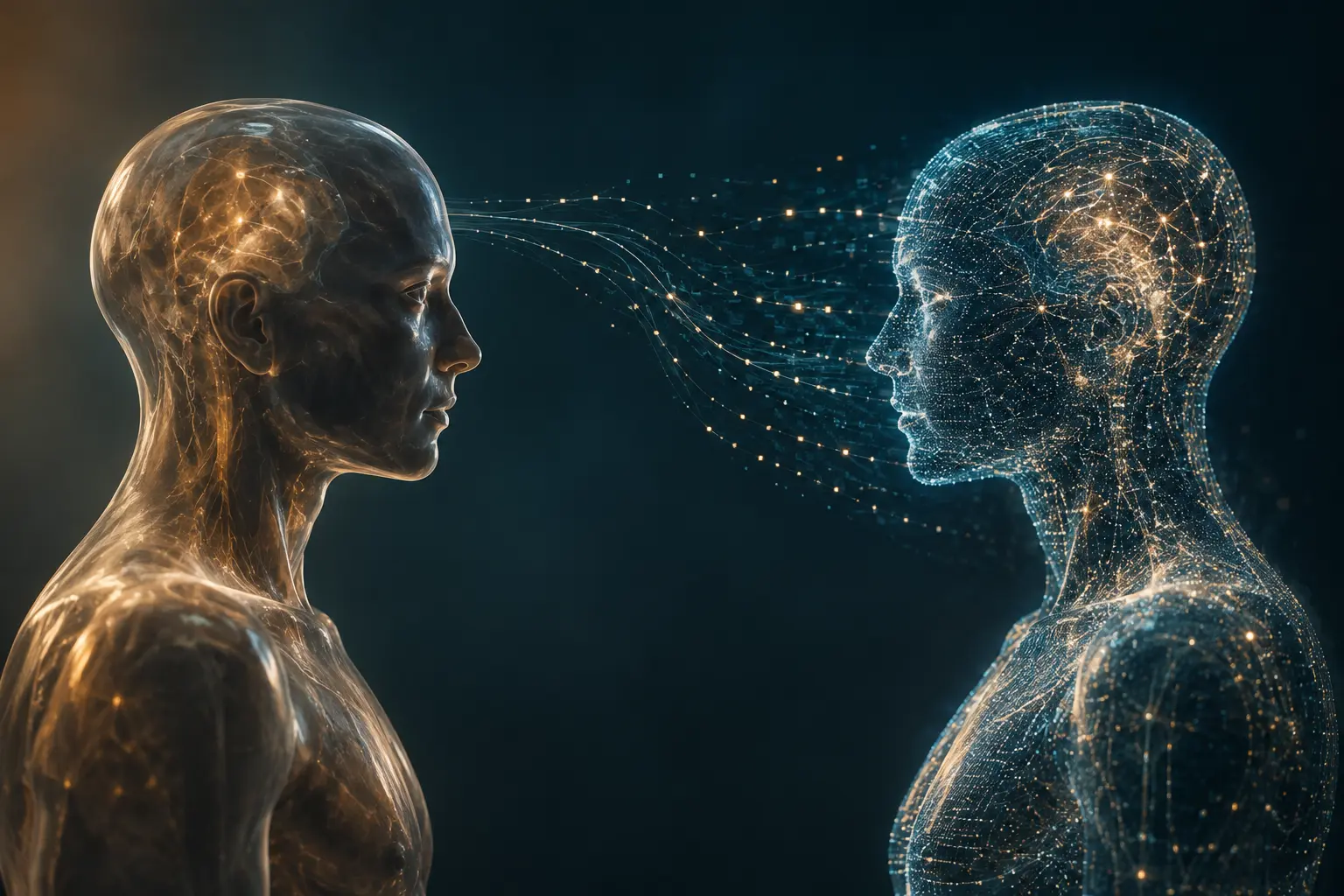
Do not compress three questions into one
Technical emulation asks whether a particular brain could be measured and modeled with enough detail for a new system to reproduce the relevant causal organization. Consciousness asks whether that system would have subjective experience rather than merely produce convincing reports. Personal identity asks whether the conscious system, if there is one, is numerically the same person as the biological original.
These are related but not interchangeable. A program could imitate your messages without emulating a brain. A sufficiently faithful brain emulation might be conscious while remaining a new subject. A theory of identity might count gradual replacement as survival while rejecting destructive scan-and-copy. Saying “the upload works” hides which result has actually been established.
A brain is not presently a file waiting to be copied
The 2008 Whole Brain Emulation: A Roadmap by Anders Sandberg and Nick Bostrom was explicitly a technology assessment, not a report that whole-brain emulation had been achieved. It separated the problem into scanning, translating biological structure into a model, simulating the model and giving it an environment in which to operate. That decomposition remains useful because it prevents a high-level analogy from standing in for engineering.
A connectome is not obviously a complete person specification. Synaptic strengths, cell states, neuromodulation, plasticity, molecular processes, bodily regulation and ongoing interaction may matter at different levels. Researchers do not agree on which details would be necessary for a conscious, behaviorally faithful emulation. A static anatomical copy and a working causal model are different achievements.
There is also no current procedure that scans a living human brain at the required resolution, validates a person-level emulation and demonstrates continuity of experience. Public discussion should therefore treat uploading as a philosophical and research scenario, not a life-extension service waiting for better storage.
Behavioral fidelity would be evidence—but of what?
If a digital counterpart remembered private events, solved new problems in your style and maintained your relationships, dismissal as “just a chatbot” would become inadequate. Persistent, flexible behavior would be evidence of a sophisticated system with a history derived from yours.
But outward fidelity cannot decide every metaphysical question. Human beings infer other human minds from behavior, bodies and shared biology. A digital emulation would preserve some of those cues and change others. The inference to consciousness might eventually become strong, but it would still be an inference. We do not yet possess a validated consciousness meter that could settle the matter from outside.
The ethical default should not be casual cruelty while philosophy waits. If a future system displayed durable preferences, distress, memory and autonomous projects, its possible moral status would deserve serious protection. That concern is compatible with uncertainty about whether it is the original person.
Similarity is not numerical identity
Two printed contracts can contain the same words while remaining two documents. Identical twins can share unusually similar genomes while remaining two people. In ordinary language, “the same” can mean qualitatively alike or numerically one and the same entity. Uploading arguments often slide between those meanings.
The branching case exposes the problem. Imagine a nondestructive scan creates two digital counterparts while the biological person remains alive. Each copy remembers being you and expects the same future. They cannot all be numerically one person after they begin receiving different experiences. The technology would have produced a branch even if every branch initially shared the same psychological pattern.
Branching does not prove that psychological continuity is worthless. It shows that continuity and one-to-one identity can come apart. A future counterpart might preserve projects, relationships, style and memory well enough to count as a meaningful successor. “A successor matters” is a different claim from “I will experience its morning.”
Different theories give different answers
Biological accounts tie our persistence to the continued life of a human organism. On that view, a digital copy is not the same individual even if it is psychologically exact. Psychological-continuity accounts emphasize linked memories, intentions, character and other mental connections. Some versions may permit survival through certain upload processes, especially gradual ones. Narrative and relational accounts emphasize the maintained life story, social recognition and practical commitments.
There is no expert consensus that one criterion settles every case. The Stanford Encyclopedia of Philosophy's review of personal identity emphasizes that identity, persistence, personhood and what matters in survival are distinct questions. David Chalmers likewise separates destructive, gradual and nondestructive uploading because the method changes the argument.
Gradual replacement feels friendlier to continuity: replace a small component, preserve function, continue the process. Yet that intuition does not constitute evidence that consciousness transfers or persists. Destructive scanning feels more obviously like copying because the original process ends. Nondestructive copying makes branching impossible to ignore. The scenarios test our concepts; they do not report laboratory results.
The first-person question cannot be answered by marketing language
From the outside, family and institutions might have reasons to treat a faithful counterpart as your continuation. It could know promises, hold memories and finish obligations. From the inside, the question is sharper: should you expect your next experience to occur there?
No demonstration video could establish that expectation merely by showing the counterpart say “I made it.” Every faithful copy would be expected to say that because it inherits memories of anticipating the procedure. Its sincerity would establish the copy's present perspective, not a bridge from your present perspective.
This is not proof that survival is impossible. It is a limit on what a behavioral result alone can prove. A defensible claim must identify the theory of persistence it uses and explain why that theory applies to the process.
A digital twin, archive and upload are different objects
A conversational memorial trained on someone's writing can preserve phrases and stories. A digital twin can model selected states for a practical purpose. A whole-brain emulation aims to reproduce the causal operation of a nervous system. An upload adds the further claim that a person continues through that emulation.
Those categories should not be sold as steps on a guaranteed ladder. More personal data can improve imitation while leaving consciousness and identity untouched. Read A Digital Twin Is Not a Second Reality for the same boundary in industrial modeling: a purpose-built representation is not a duplicate world.
What the thought experiment is useful for now
- Separate preservation from survival. Decide whether the goal is an archive, an interactive memorial, institutional continuity or first-person continuation.
- Name the identity criterion. Do not use “you” until the biological, psychological or relational standard is explicit.
- Test branching. Ask what the theory says if two equally faithful successors exist.
- Protect possible subjects. Uncertainty about identity does not erase potential welfare, consent or exploitation concerns.
- Reject present-tense promises. No current service has demonstrated human whole-brain emulation, digital consciousness or personal survival by upload.
- Preserve ordinary continuity. Relationships, records, advance directives and accountable institutions matter whether or not radical technologies arrive.
The bottom line
A perfect copy would make the identity problem harder, not disappear. It could be psychologically continuous, socially important, morally considerable and still be numerically distinct from the person whose pattern it inherited.
The honest conclusion is conditional. If a future system reproduces the relevant organization, it may support a serious case for consciousness. If a defensible theory of personal identity treats that process as continuity, it may support a case for survival. Neither “digital” nor “identical” supplies those premises for free.
Sources and disagreement map
- David J. Chalmers, Uploading: A Philosophical Analysis, for destructive, gradual and nondestructive upload scenarios and the arguments surrounding consciousness and identity.
- Anders Sandberg and Nick Bostrom, Whole Brain Emulation: A Roadmap, archived by the University of Oxford, for the technical decomposition and its explicit speculative status.
- Stanford Encyclopedia of Philosophy, Personal Identity, for the distinction among identity, persistence and what matters in survival.
- For the current explanatory gap, read Consciousness Is Still the Weird Part.
- For why a constructed self-representation need not be unreal, read A Self-Model Is Not a Fake Self.
END OF TRANSMISSION 041
Keep the question. Test the model.
Choose the narrowest claim the evidence can carry, then leave room for revision.