You walk into a dim kitchen and briefly see a person where a coat is hanging. The mistake vanishes when you turn on the light. The episode is a compact lesson: perception is not a passive photograph, but neither is it a private movie indifferent to the world. A prior interpretation arrived early; better sensory evidence corrected it.
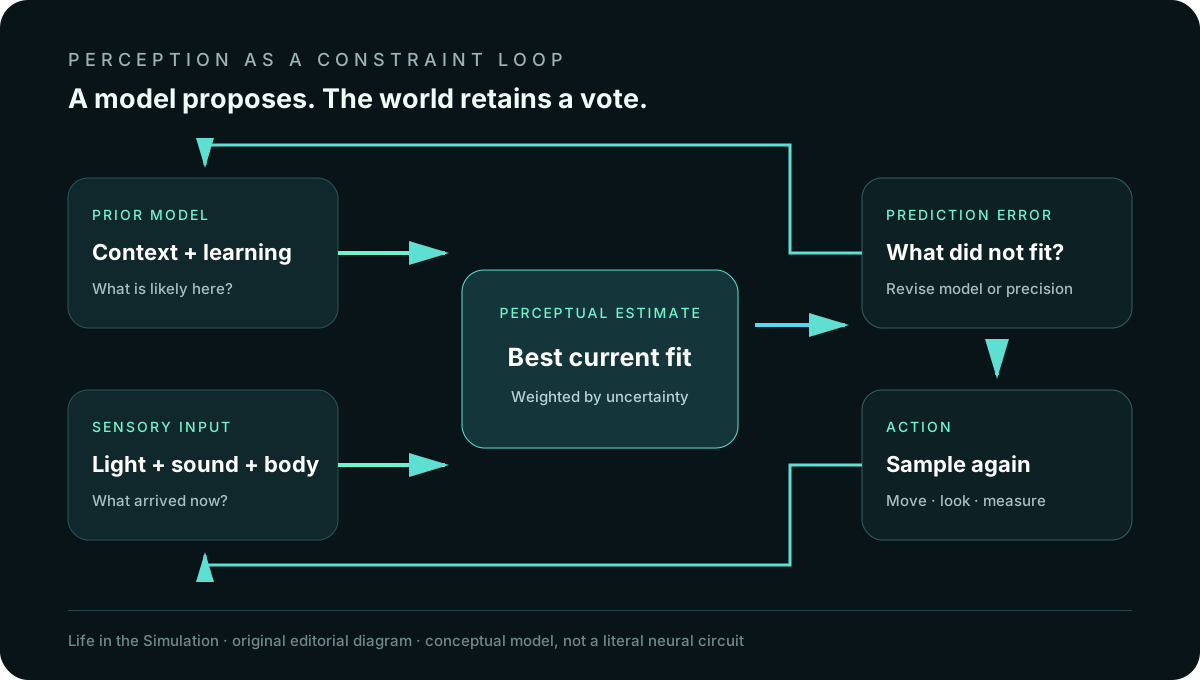
Predictive-processing theories try to explain that balance. In broad form, they propose that the nervous system uses learned models to anticipate sensory input and updates those models when prediction errors remain. The family includes several mathematical and biological proposals, not one finished theory. Its central insight is important. The internet slogan that follows—“reality is a controlled hallucination”—is memorable, but often collapses distinctions the science needs.
Why a nervous system has to infer
Sensory receptors register effects, not complete causes. A pattern of light on the retina might come from several objects under several lighting conditions. A sound at the ear does not arrive labeled with its source. The system must use context, learned regularities and signals from other senses to settle on an interpretation quickly enough to act.
This is not a defect added by modern media. It is the ordinary problem of perception. Expectations can make interpretation faster and more stable. They can also bias it. A useful account therefore has to explain both successful constancy and systematic illusion without pretending that inference means arbitrary invention.
The predictive-processing proposal
Andy Clark's influential 2013 target article describes a hierarchical system in which higher levels generate predictions and lower levels carry mismatches forward. Karl Friston's free-energy framework links perception, learning and action through optimization of a formal bound on sensory surprise. These ideas overlap, but they are not interchangeable, and researchers debate their neural implementation and explanatory reach.
One crucial variable is often called precision: roughly, how much weight the system gives a signal or prediction under uncertainty. When a street sign is clear and close, detailed input should dominate. When it is distant in fog, prior knowledge about language and context does more work. Attention can change which errors matter. Action can change the sample—move closer, turn on a light, ask the speaker to repeat.
What the evidence supports
Expectation changes perceptual decisions and activity in sensory systems. Reviews by Christopher Summerfield and Floris de Lange and colleagues summarize experiments in which prior probabilities, cues and learned regularities alter what people report and how expected and unexpected stimuli are processed. This is evidence that top-down expectations participate in perception, not merely in a later verbal story about it.
The direction of neural effects is not captured by one slogan. Expected stimuli can produce less overall activity in some settings, as an efficient-coding or prediction-error account might anticipate, while sharpening a representation or improving behavior in others. Task, timing, uncertainty and measurement level matter. “The brain predicts” names a research program; it does not supply the result of every experiment in advance.
Why “hallucination” is a risky compression
In ordinary and clinical language, a hallucination is a perception-like experience without a corresponding external stimulus. Waking perception usually has a corresponding cause and remains coupled to it through continuing error correction. Using the same word for both emphasizes their shared generative machinery. It also hides the most important difference: constraint.
The phrase becomes especially misleading when it moves from mechanism to ontology. A brain using a model does not imply there is no world. Models are useful precisely because they encounter structure that resists them. The coat becomes a coat under better light. A measurement surprises us. Another observer can check. The theory explains how access to a world may be indirect and constructive; it does not show that the world is fictional, digital or simulated.
Nor does prediction make error suspiciously special. A thermometer also uses a physical transformation rather than copying temperature as a tiny substance. Mediation does not equal fabrication. The relevant question is whether the process tracks stable causes well enough to guide action and improve after mismatch.
What actual hallucinations can teach
Predictive accounts of hallucination ask whether the balance among priors, sensory likelihoods and precision is altered. Research does not offer one simple “strong priors cause hallucinations” verdict. Reviews of psychosis describe competing findings and models: unusual experiences may involve overly weighted expectations at one level, unreliable sensory evidence or prediction errors at another, and differences in learning, attention or neuromodulation.
That disagreement matters. A framework can organize hypotheses without yet identifying a single mechanism for every patient or condition. Hallucinations also occur in different neurological, sensory and nonclinical contexts. This essay is about a scientific model, not a way to diagnose a person from their beliefs or experiences.
The simulation-theory leap
Predictive processing and the simulation hypothesis answer different questions. The first is about how organisms estimate causes from sensory signals and act under uncertainty. The second is about the underlying origin or substrate of the world. A simulated agent could use predictive processing. A nonsimulated biological agent could too. The perceptual architecture does not discriminate between those possibilities.
Likewise, showing that an illusion is constructed does not show that every scene is false. To argue for a simulated universe, one still needs the work described in what would count as evidence: a prediction that differs from competing explanations and survives testing. Vivid experience, dreams and perceptual inference cannot carry that burden by themselves.
A practical way to use the theory
- Name the prior. What did context, habit, fear or recent exposure prepare you to see?
- Improve the sample. Change distance, lighting, timing or source. Ask what observation would discriminate among interpretations.
- Seek an independent channel. Use another sense, instrument, document or observer whose error is not identical to yours.
- Watch correction speed. A model that updates after clear mismatch is doing different work from a belief protected from every possible result.
- Calibrate the stakes. Fast inference is fine for catching a ball. Medical, legal and financial judgments deserve slower checking and qualified expertise.
This is a narrow reality audit: not “distrust perception,” but identify the model and then give the world a fair chance to answer back.
What is established, disputed and open
Sourced fact
Expectations and context can bias perceptual judgments and alter neural responses to expected and unexpected sensory input.
Expert disagreement
Researchers dispute how predictive coding is implemented, how it relates to attention and representation, and whether broad free-energy formulations are uniquely explanatory.
Reasonable inference
Calling normal perception “hallucination” obscures the continuous sensory and behavioral constraints that usually distinguish it from perception without an external cause.
Speculation
A future theory may unify perception and action more cleanly than current predictive-processing families. That would still require separate evidence about the universe's substrate.
Sources and boundary
- Clark, A. (2013), Whatever next? Predictive brains, situated agents, and the future of cognitive science.
- Friston, K. (2010), The free-energy principle: a unified brain theory?
- Summerfield, C. & de Lange, F. P. (2014), Expectation in perceptual decision making.
- de Lange, F. P., Heilbron, M. & Kok, P. (2018), How do expectations shape perception?
- Sterzer, P. et al. (2018), The predictive coding account of psychosis.
This essay separates a family of models from claims about a particular person's experience. It does not provide clinical guidance and does not treat perceptual fallibility as evidence that reality is unreal.
END OF TRANSMISSION 026
Keep the question. Test the model.
Choose the narrowest claim the evidence can carry, then leave room for revision.