Consciousness is unusually close and unusually difficult to measure. Your own experience is immediate to you. Everyone else's experience arrives through evidence: words, choices, physiology, neural activity, history and context. The evidence can be strong. It is still not a window someone else can climb through.
This does not make consciousness unknowable or scientific work pointless. It changes the claim. Researchers can test which reports, behaviors and brain processes reliably travel with particular conscious states. Clinicians can use repeated structured assessments to reduce misdiagnosis. Competing theories can make predictions and lose ground when those predictions fail. What remains unavailable is a universal instrument that reads experience directly and returns a context-free answer.
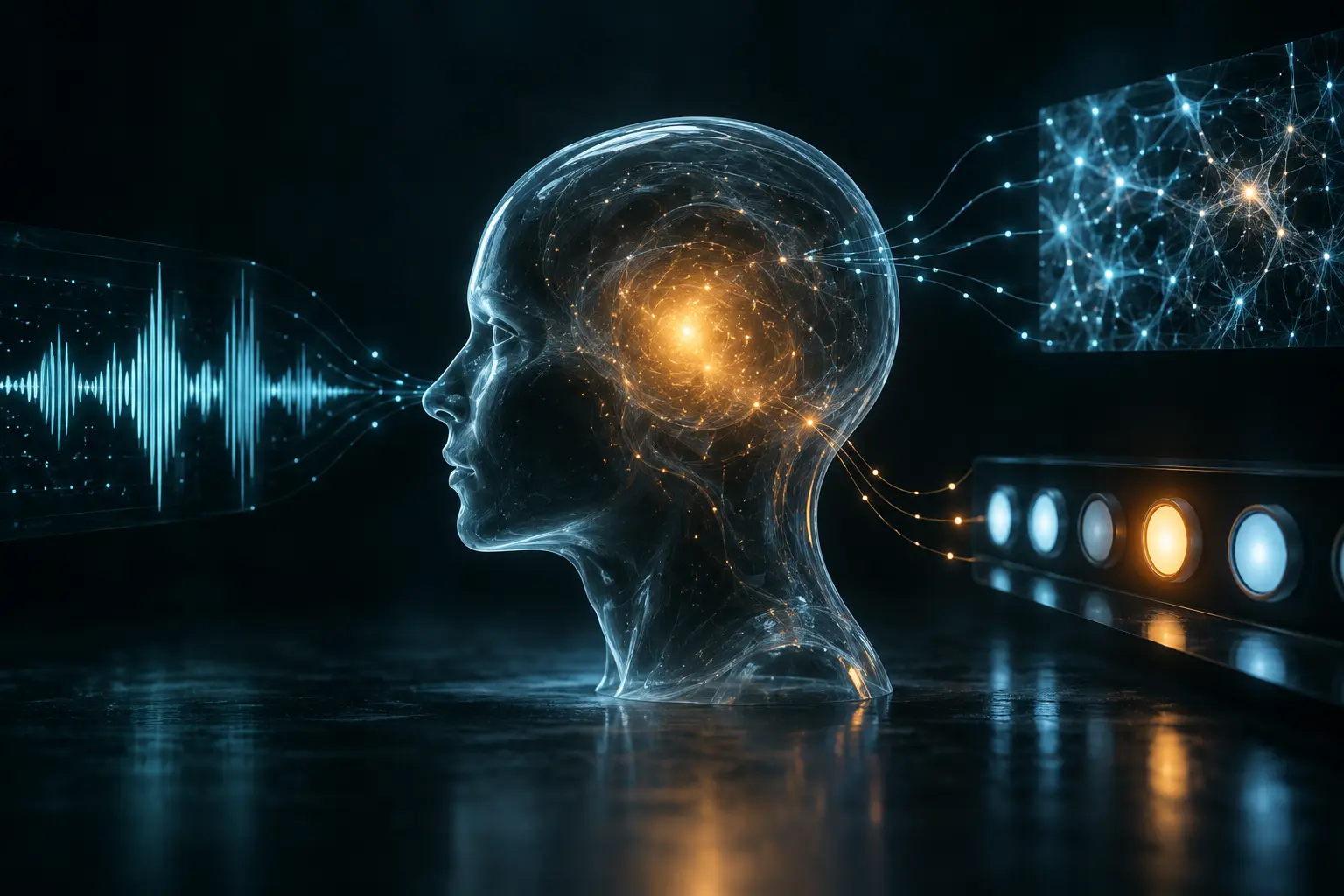
First define what the test is supposed to detect
“Consciousness” can refer to being awake rather than unresponsive, having a specific perceptual experience, being able to access information for reasoning and report, or the felt quality of experience itself. A test optimized for one target may be poor evidence for another. Eye opening is relevant to arousal but does not inventory experience. Accurate discrimination can show access to information without describing how that information feels. A verbal report can describe experience while also depending on language, memory, motor control and willingness.
The first error is therefore grammatical: treating a family of questions as one question. Before evaluating a study or claim, rewrite it narrowly. Is the claim about level of consciousness, content of experience, access to information, self-awareness, pain, metacognition or phenomenal experience? If the target remains vague, any result can be promoted after the fact.
Five evidence channels, five failure modes
| Channel | What it can support | What can break the inference |
|---|---|---|
| First-person report | A subject says what was experienced | Language, memory, demand, deception or inability to report |
| Task behavior | Information guided a discrimination or action | Automatic processing, motor limits or a task that measures another capacity |
| Physiology | A bodily state covaries with arousal, pain or attention | Many conscious and nonconscious causes share the signal |
| Neural measurement | A measurable pattern accompanies a condition or report | Correlation, preprocessing, task demands and theory-dependent interpretation |
| Intervention | Changing a process changes reports or behavior | Broad downstream effects and incomplete specificity |
No channel is useless. Reports are indispensable when they are possible. Behavior lets investigators test discrimination and control. Brain measurements expose timing and location that introspection cannot provide. Interventions can narrow causal stories. The mistake is to ask one channel to do every job.
Report is evidence, not the whole phenomenon
Many experiments compare what participants say they saw with brain activity or performance. That is sensible, but the act of reporting recruits attention, working memory, decision and motor preparation. A neural signal near a report may reflect the experience, the process of making it available for report, or the response itself. “No-report” paradigms try to reduce that confound by inferring perceptual content from eye movements or other measures, but they replace one inference with another rather than eliminating inference.
This is why attention is not a safe substitute for consciousness. Selection can alter what is processed and reported without answering whether unattended information was experienced. The distinction is experimentally difficult, not merely semantic.
A correlate is not a meter
A brain image, electrical signal or connectivity measure is produced through instruments, preprocessing and analysis choices. Researchers then relate that measurement to a task and theory. The resulting pattern can be informative without being a picture of experience. As the site's brain-scan guide argues, measured signal, modeled contrast and mental interpretation are separate layers.
The 2025 COGITATE adversarial collaboration is a useful case because proponents of integrated information theory and global neuronal workspace theory agreed in advance on contrasting predictions. Multimodal results aligned with some predictions from both theories and challenged central predictions from both. The study advanced the field without producing a winner or a universal test. That is what real theory testing often looks like: the space of defensible claims changes, but ambiguity does not vanish.
Hard cases reveal why repeated assessment matters
In disorders of consciousness, a person may be unable to speak or make reliable movements. A missed command-following response can reflect fatigue, sensory impairment, motor limitation or fluctuating state. Research on the Coma Recovery Scale–Revised has found that repeated assessments can change diagnosis, with additional examinations detecting signs missed in a single session. The lesson is not that any positive response proves a rich inner life. It is that a single negative observation has a detection limit.
Clinical diagnosis belongs to qualified professionals using validated protocols, history and repeated observation. A consumer device, conversational impression or isolated brain image should not be used to diagnose consciousness, prognosis or pain. When the consequence is care, the burden is to reduce both false certainty and false absence.
Animals and AI expose different gaps
With nonhuman animals, investigators combine behavior, comparative neurobiology, learning, flexible action and responses to injury or analgesia. Species differences make human-style report unavailable, but absence of speech is not absence of evidence. Ethical decisions often operate under uncertainty because waiting for proof can itself cause harm.
With AI, fluent report creates the opposite temptation. A language model can produce a compelling sentence about feelings because producing language is its designed capability. That output is evidence about the system's behavior and training, not direct evidence of subjective experience. Conversely, denying consciousness solely because a system is artificial would also be an unsupported shortcut. The site therefore keeps intelligence, self-description and consciousness separate.
The asymmetry matters: human reports sit inside a thick network of shared biology, development, embodiment and reciprocal behavior. Current AI reports do not arrive with the same evidence base. That does not settle the future. It prevents an output from being mistaken for a meter.
A consciousness-evidence ladder
- Name the target. Level, content, access, self-awareness, pain or phenomenal experience?
- Name the subject and context. Healthy adult, infant, patient, animal or artificial system?
- Separate channels. Record reports, behavior, physiology, neural measures and interventions independently.
- List prerequisites. What language, memory, sensory or motor capacity must work for the test to succeed?
- List alternatives. Could the result reflect arousal, attention, task learning, response preparation or artifact?
- Ask what the theory predicted first. Prefer preregistered contrasts over stories fitted after seeing the pattern.
- Repeat when states fluctuate. One observation can miss a capacity that appears intermittently.
- Scale the conclusion. Say “supports,” “is consistent with” or “failed to detect” when that is what the evidence earns.
- Keep ethics visible. Uncertainty can justify precaution; it cannot be disguised as proof.
What would not count as a consciousness test
- A chatbot saying “I feel” without independent evidence about architecture and state.
- A single brain region lighting up in a contrast map.
- Passing one intelligence, imitation or self-recognition task.
- Failing to respond once when sensory, motor or arousal limits are unknown.
- A theory assigning a number to every system without validated links to the target phenomenon.
- A vivid personal intuition that something seems alive—or obviously empty.
The point is not to demand impossible proof. It is to keep a measurement from changing its name as it moves through an argument. Use the site's claim–evidence–inference protocol to preserve those joints.
Claims and boundaries
Sourced fact: contemporary consciousness science uses multiple behavioral and neural methods; a large preregistered adversarial test in 2025 supported and challenged predictions from two leading theories; repeated structured clinical assessments can reveal signs missed once. Inference: consciousness judgments are stronger when independent channels converge and their prerequisites are explicit. Judgment: readers should reject both “we have a consciousness detector” and “nothing can be known.” Not claimed: consciousness is supernatural, one theory is correct, all systems deserve identical moral status or this essay can diagnose any person or machine.
Primary and institutional sources
- COGITATE Consortium: Adversarial testing of global neuronal workspace and integrated information theories of consciousness, Nature 642 (2025), for preregistered multimodal predictions and mixed results.
- COGITATE open multisite fMRI dataset, Scientific Data (2026), for open methods and data behind conscious visual-perception research.
- Wannez et al.: repeated behavioral assessment in chronic disorders of consciousness, for the diagnostic value and limits of repeated CRS-R examinations.
- Stanford Encyclopedia of Philosophy: Consciousness, for the distinctions among concepts, access and phenomenal experience.
END OF TRANSMISSION 058
Keep the question. Test the model.
Choose the narrowest claim the evidence can carry, then leave room for revision.