A power bank is stored energy, a charging protocol, a thermal system and a travel-regulated spare battery in one box. “20,000 mAh” tells you less than the shelf card suggests. It does not state usable energy at the device, output speed, recharge time, cable requirements or whether the exact model has a safe recall history.
Start with the job: keep one phone alive through a long day, recharge a tablet during travel, or extend a USB-C laptop during a power-constrained session. Those jobs point to different capacity, power, mass and safety tradeoffs. Buying the largest permitted brick can be worse than carrying a small reliable bank and using it deliberately.
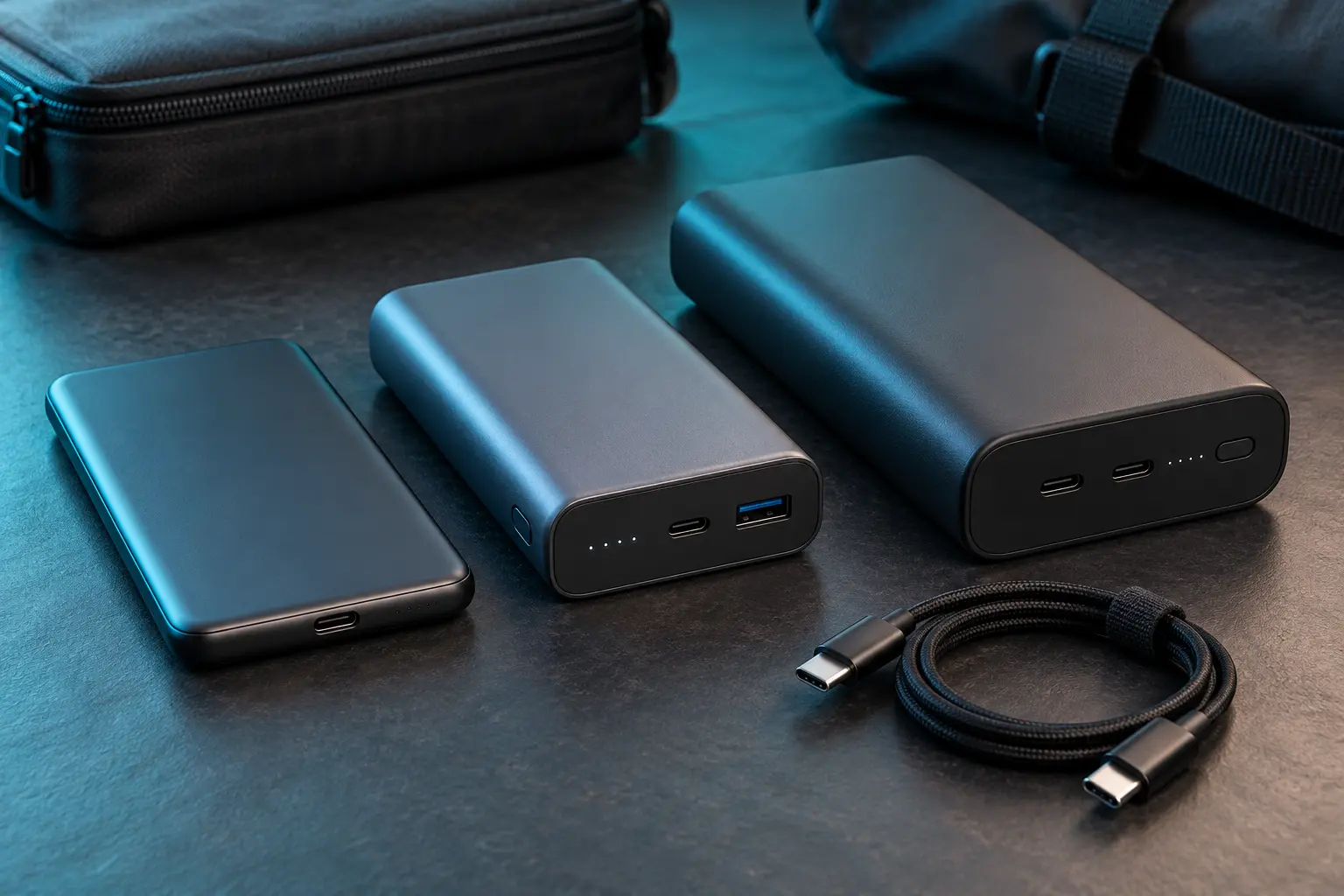
Define the survival job
- Phone-day reserve: one partial or full phone recharge, low mass, one reliable USB-C port.
- Travel bank: phone plus earbuds or tablet, clear Wh marking, protected ports and a carry-on plan.
- Laptop extension: the laptop's accepted USB-PD profile, enough sustained output and a cable rated for it.
- Emergency communications: long storage intervals, simple state check, periodic inspection and a no-cloud device plan.
- Multi-device station: shared output behavior matters; total advertised wattage may be redistributed when another port is used.
If the real job is keeping a router, medical device, desktop or home system running, a portable consumer bank may be the wrong architecture. Use documented backup equipment designed for that load and involve a qualified professional when continuity is safety-critical. The UPS guide covers stationary power continuity.
Convert capacity into the same unit
Battery-cell capacity is often advertised in milliamp-hours at the cell's nominal voltage. Airlines regulate lithium-ion batteries by watt-hours. Devices store energy in watt-hours. Convert before comparing:
Rated energy is not the energy delivered into the device battery. Voltage conversion, heat, cable loss, the bank's cutoff and the device's own charging system reduce usable energy. Marketing that divides one mAh number by another can compare capacities measured at different voltages. Prefer a documented Wh rating and independent efficiency testing when available. Do not invent a universal percentage.
| Need | Useful starting class | Main compromise |
|---|---|---|
| Small phone reserve | Roughly 15–25 Wh | May not deliver a full recharge |
| One or two phone recharges | Roughly 30–50 Wh | More weight and recharge time |
| Tablet or light multi-device use | Roughly 50–75 Wh | Port sharing and carry burden |
| Laptop-capable travel bank | Often 70–100 Wh | High output, cable and airline checks become critical |
These are job classes, not promises of runtime. Confirm the device battery, workload and exact bank documentation.
Capacity is duration; watts are capability
A large bank with a low-output port may charge a phone slowly and fail to support a laptop under load. Check the maximum output of the specific USB-C port and the exact fixed or programmable USB-PD profiles. “100 W” on a product page may apply to one port only, only when other ports are unused, or only with a compatible 5-amp cable.
The device and source negotiate power. A bank does not force its maximum into a correctly implemented compatible device. The device requests a supported profile. But the bank, cable and device must all support the path. A 60 W cable can cap a higher-power bank; proprietary fast-charge modes may not transfer across brands. Read the device's official charging requirements and the bank manual.
USB-IF says certified USB-C-to-USB-C cables in its compliance program must carry power markings of 60 W or 240 W, with data-rate markings where applicable. Use the USB-C cable guide and verify the product in the USB-IF database when certification matters.
Input speed determines whether the bank is ready tomorrow
A high-capacity bank can take most of a day to refill from a weak charger. Check maximum USB-C input power, supported profiles, whether charging input shares a port with output and whether pass-through use is documented. Do not assume that a bank capable of delivering 65 W can accept 65 W.
Pass-through charging adds heat and dependency. Use it only when the manufacturer documents the mode, and do not bury the bank in bedding, luggage or a tight pouch while charging. A power bank is not a permanent UPS unless it is specifically designed and documented for continuous operation.
Airline rules use watt-hours, not marketing categories
The U.S. Federal Aviation Administration states that spare lithium batteries, including power banks and portable chargers, must be in carry-on baggage and cannot be checked. Lithium-ion batteries from 0–100 Wh are generally allowed for personal use. Batteries from 101–160 Wh require airline approval and are limited to two larger spares per passenger. Above 160 Wh, they are forbidden on passenger aircraft.
FAA guidance was updated August 10–11, 2026 and also warns that airlines may impose stricter quantity and Wh limits. Check the carrier immediately before travel. If a carry-on is gate-checked, remove the bank and keep it in the cabin. Protect terminals and the unit from damage. The Wh rating should be legible. Damaged or recalled batteries that may spark or generate dangerous heat must not travel.
Treat heat, damage and recalls as stop conditions
Lithium-ion cells can enter thermal runaway after damage, overheating, water exposure, overcharge or manufacturing defect. Stop using and charging a bank that swells, cracks, leaks, smells unusual, becomes unexpectedly hot, smokes or has damaged ports. Move away from combustible material if it is safe to do so, follow local emergency guidance and do not handle a smoking or burning battery.
Check the exact model and serial number against the U.S. Consumer Product Safety Commission recall database. CPSC's September 24, 2026 NEWDERY recall involved a specific model after reports of explosion and ignition; another 2025 INIU recall covered specified BI-B41 serial groups. These cases do not prove every bank from a brand is unsafe. They show why the exact model and serial matter more than a marketplace title.
Do not put a recalled or damaged lithium-ion bank in household trash, curbside recycling or an ordinary retail battery box. CPSC advises contacting the municipal household hazardous-waste program for instructions because recalled batteries may require a different route.
Verify the record, not the printed symbol
Look for the exact regional model in the appropriate safety and USB compliance databases. A familiar mark in a product image is not proof that the unit in hand was certified. Match manufacturer, model and electrical ratings. Prefer a vendor with a published manual, recall contact, warranty route and clear end-of-life instructions.
Certification reduces particular risks under stated tests. It does not guarantee perfect manufacturing, eliminate misuse or predict support life. Marketplace ratings and review counts are not substitutes for a technical record.
Port count can hide shared limits
Read the output table for one-port and multi-port use. A bank may offer 65 W from one USB-C port alone, then divide power when a second device connects. Some ports can be input-only, output-only or both. USB-A may exist for older accessories but often does not provide the same negotiated profiles as USB-C.
For a laptop, test the documented combination at home before travel: bank port, cable, laptop port, workload and remaining charge. A laptop may report “connected, not charging” while drawing enough power to slow discharge. That can still be useful, but it is not the same as charging.
The no-buy and smaller-buy options
- Replace a worn phone battery when service is available and the device otherwise meets the need.
- Carry the correct wall charger and cable when outlets are reliable.
- Use low-power mode, offline maps and a planned communication window.
- Borrow a travel bank for an infrequent trip after checking condition and recall status.
- Choose a smaller bank if it will actually be carried and kept within a comfortable margin.
- Do not buy a wireless magnetic bank when cable charging better fits efficiency, heat and case compatibility.
The fifteen-minute purchase test
- Name the device and minimum survival job.
- Record the device battery Wh and official charging requirement where available.
- Choose a capacity class and write the maximum carry weight.
- Verify the bank's Wh label; do not compare mAh alone.
- Verify the specific USB-C output profiles and one-port wattage.
- Verify multi-port behavior if more than one device will charge.
- Verify USB-C input power and expected bank recharge time.
- Match the cable's power capability and connectors.
- Check exact model and serial against recall databases.
- Check safety and USB-IF certification records where claimed.
- Read storage, operating-temperature and pass-through instructions.
- Confirm airline and carrier rules for every planned trip.
- Define inspection, replacement and hazardous-waste routes.
Who should skip a consumer power bank
Skip it when failure could interrupt life-sustaining medical equipment, safety communications without redundancy, unattended heating or another high-consequence load. Use equipment designed, documented and professionally approved for that purpose. Skip an unknown, damaged, swollen or recalled unit regardless of apparent capacity. Skip a giant bank when the real need is one partial phone recharge.
Claims and boundaries
Sourced fact: FAA rules require power banks in carry-on baggage and set watt-hour thresholds; USB Power Delivery negotiates supported power profiles; current CPSC recalls document model-specific fire and burn hazards. Inference: rated Wh, output profiles, cable capability and recall status are more useful buying criteria than headline mAh. Judgment: a smaller bank with a verified path is often better than the largest permitted unit. Not claimed: any category example is safest, any brand is endorsed, the illustrated banks exist, or a label guarantees lifetime safety.
Official travel, safety and standards references
- FAA: Airline Passengers and Batteries, updated August 10, 2026, for carry-on status, Wh limits and airline approval.
- FAA PackSafe: Lithium Batteries, updated August 11, 2026, for terminal protection, damage and thermal-runaway guidance.
- USB-IF: USB Charger and Power Delivery, for negotiated power and the USB PD architecture.
- USB-IF: Cables and Connectors and certified-product search, for cable markings and compliance records.
- CPSC: September 24, 2026 NEWDERY power-bank recall, for model-specific fire risk and disposal directions.
- CPSC: INIU BI-B41 power-bank recall, for serial-specific recall checking.
END OF FIELD GUIDE 085
Keep the question. Test the model.
Choose the narrowest claim the evidence can carry, then leave room for revision.