A five-dollar floor alarm and a professionally installed whole-home shutoff can both be sold as leak protection. They do not see the same area, detect the same failure, depend on the same infrastructure or take the same action.
Start with the event you need to catch and the person or mechanism that can respond. A detector that sends a perfect push notification to a phone nobody can answer is not a complete system. A valve that closes automatically can limit damage, but a false shutoff can also interrupt an occupied home, appliance or business. The right design is a chain: detect, communicate, decide, act and verify.
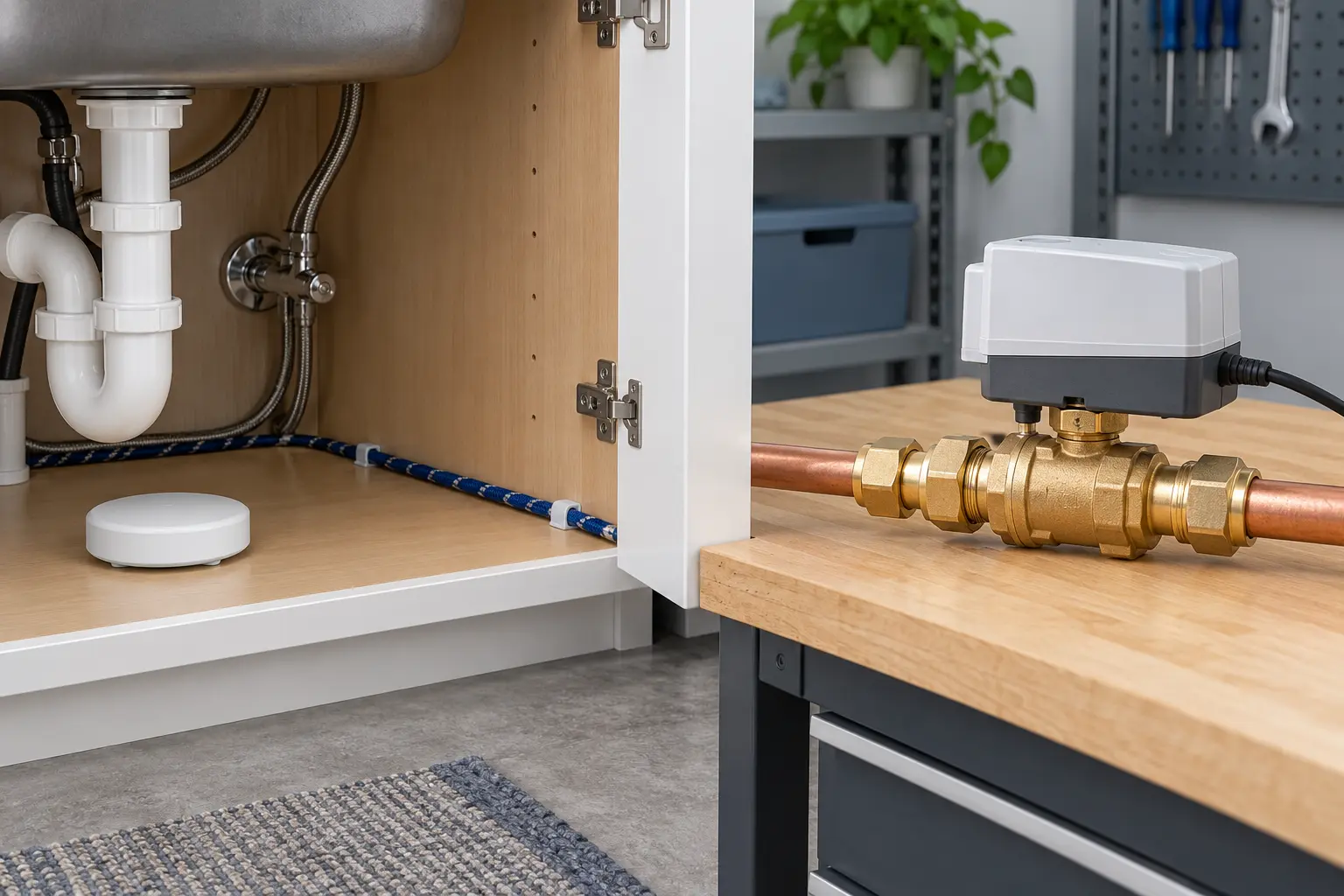
Four categories that should not be collapsed
| Category | Best at | Main limitation |
|---|---|---|
| Point contact sensor | Low-cost detection at one known low point | Water must reach that small footprint |
| Sensing cable or rope | Coverage along an edge, appliance or irregular path | Routing, power and compatible controller matter |
| Whole-home flow monitor | Detecting unusual use through the main supply | Must distinguish normal patterns; may miss non-plumbing water |
| Automatic shutoff | Taking action when nobody can respond | Installation, valve fit, power, policy and false closures require planning |
Some systems combine categories. A floor detector can tell an inline valve to close. A flow monitor can learn usage and operate its own valve. A sensing cable can cover an entire appliance perimeter. Treat the components and dependencies separately even when one brand sells them as a bundle.
Step 1: map where water would begin and travel
Walk the property before shopping. Look at supply connections, drains, pans, pumps and places where water can arrive from outside the monitored plumbing. Common inspection points include washing machines, water heaters, under-sink cabinets, refrigerators with water lines, dishwashers, toilets, sump pumps, utility rooms and the lowest area below vulnerable piping.
Do not assume the visually convenient spot is the hydrologically useful one. Floors slope. Cabinets have lips. A detector on a shelf will not find water collecting behind an appliance. Use a small amount of clean water only when it is safe to observe the path, and never introduce water near electrical equipment. A plumber, building professional or manufacturer can help with uncertain placement.
The U.S. EPA WaterSense guide distinguishes spot-sensing devices from flow-monitoring systems and emphasizes selection and maintenance. Its central lesson is useful: the technology should match the leak type, home and response you need.
Point sensors: cheap coverage where the path is known
A point sensor usually has exposed contacts on its base or a small probe. Water bridges the contacts and triggers an alarm. The strengths are price, simplicity and the ability to put several units near known hazards. Some are local-only; others use a hub, Wi-Fi, Bluetooth, Zigbee, Thread or another radio for notifications.
Check how the local alarm behaves without internet, how batteries are reported, whether the sensor repeats alerts and whether silence or low volume could be missed behind a closed door. A connected sensor should still make useful local noise if the network or cloud is unavailable. Remote alerts add reach; they should not be the only signal.
Do not buy one puck and place it in the middle of a utility room as symbolic protection. Point detection is a coverage problem. Multiple ordinary sensors at plausible low points can be better than one feature-rich sensor in the wrong place.
Sensing cable: coverage along an edge
A sensing cable detects water along a length rather than at one small base. It can follow the perimeter of a water heater, run under cabinets or reach behind appliances. That is useful when the exact first-contact point is uncertain but the path is bounded.
Inspect supported cable length, replaceable sections, drying and reset procedure, bend limits, mounting method and whether a damaged or disconnected cable produces a fault. Determine whether the controller needs mains power and what remote notifications require. Eve's current Water Guard documentation, for example, describes a two-meter sensing cable, extension support, a local siren and platform requirements for away-from-home notifications. Those details describe one implementation, not a universal standard.
Flow monitoring: a different signal
A whole-home flow monitor observes water movement in the supply line. It can detect usage that is unusual in duration, rate or timing and may reveal leaks that never reach a floor sensor. But it is reasoning from flow, not touching water. Normal events such as irrigation, guests, filling a tub or a slow appliance cycle can resemble anomalies until the system is configured.
Flow monitoring also cannot detect every water source. Roof intrusion, groundwater, a leaking drain while water is not crossing the monitored point or a failed appliance reservoir may bypass the main-supply signal. Pair technologies when the failure modes justify it.
Automatic shutoff: action with consequences
An automatic shutoff adds an actuator or integrated valve that can close the water supply after a rule or sensor alert. This can reduce response time when the building is empty. It also raises the stakes of compatibility and false decisions.
Verify pipe size and material, valve location, pressure conditions, available power, Wi-Fi or hub requirements, manual operation, battery backup options, freeze conditions and local plumbing code. Confirm what happens after power or internet failure and how occupants restore service. Do not install a device on a fire-sprinkler or suppression line unless the system and code explicitly allow it. Moen's current Flo documentation says its shutoff belongs after the existing main shutoff and pressure-reducing valve where present, before branch lines, and not on fire-suppression or hot-water distribution lines. The manufacturer recommends a licensed plumber or installer.
Those instructions are product-specific. Another valve may have different restrictions. Use the exact manual and a qualified plumber. A buying guide cannot safely infer installation from a photograph or pipe diameter alone.
The selection card
- Failure: name the leak or intrusion you need to catch.
- Coverage: mark where water is likely to touch a point, line or flow meter.
- Response: choose local alarm, remote notice, automatic closure or a combination.
- Dependencies: list batteries, outlet, hub, router, cloud account, phone and paid service.
- Compatibility: verify platform, radio, valve, pipe, code and installer requirements from current documentation.
- Failure behavior: ask what happens when power, network, cloud, sensor or actuator fails.
- Maintenance: assign testing, battery replacement, cable inspection and valve exercise.
- Recovery: write who can locate the main shutoff, inspect the source and restore service.
Use the smart-home infrastructure guide if a sensor depends on Matter, Thread, a proprietary bridge or a particular ecosystem. Radio compatibility does not prove that two devices expose the same automation or safety behavior.
A test is part of the product
Test according to the manufacturer's instructions after installation and on its recommended schedule. Confirm the local alarm, app or hub alert, recipient, automation and valve response separately. A notification test does not prove that the sensing surface works. A valve command does not prove that the leak rule will issue it.
For automatic closure, coordinate the test so occupants and water-dependent equipment are not surprised. Confirm manual override and inspect for leaks after any plumbing work. Record the result in the digital change log, including battery or firmware changes that could alter behavior.
Connectivity adds an ownership question
A cloud-connected water system can reveal occupancy-like patterns and depends on an account, app and vendor service. Review data collection, account security, sharing, export, deletion, support horizon and behavior if the service ends. Prefer unique credentials and multi-factor authentication when offered. The ordinary-person threat model can help decide whether remote access is worth the exposure.
Local-only alarms avoid some account risk but cannot notify you away from home. There is no universal winner. State which failure matters more.
The no-buy path
- Locate, label and exercise the existing main shutoff if it can be operated safely.
- Inspect supply hoses, visible fittings, pans and drains; replace or repair according to manufacturer and professional guidance.
- Read the water meter during a known no-use period using the utility's instructions.
- Arrange a trusted responder for long absences and share the shutoff location.
- Address known plumbing defects before adding monitoring around them.
- Ask the insurer about documented requirements, but do not assume a discount or coverage outcome.
Use product pages as compatibility records
Current official documentation illustrates category tradeoffs. Eve Water Guard documents cable coverage, local alarm and platform requirements. Moen documents point detectors, sensing-cable accessories and an inline Flo shutoff with installation constraints. These are examples of system architecture, not endorsements or proof of independent performance.
Products, subscriptions, apps and support policies change. Recheck the exact current model manual before purchase. For automatic shutoff work, use a licensed plumber or qualified installer and follow local code.
Claims and boundaries
Sourced fact: EPA WaterSense distinguishes leak-detection and flow-monitoring approaches and provides selection and maintenance guidance; manufacturer documentation describes model-specific coverage, power, platform and installation requirements. Inference: designing the response chain before buying reduces false confidence and stranded devices. Judgment: automatic shutoff deserves professional installation and explicit recovery planning. Not claimed: any named product prevents all damage, qualifies for an insurance discount, meets an unstated certification or was tested by this publication.
Official and manufacturer references
- U.S. EPA WaterSense: Leak Detection and Flow Monitoring Devices, for technology categories, selection and maintenance guidance.
- EPA WaterSense: Know Your Flow and Curb Water Waste, February 2026 consumer guide.
- Eve Water Guard official support, for one cable-sensing implementation and its current requirements.
- Moen smart-water technical guides, for detector, cable and shutoff documentation.
- Moen Flo shutoff installation guidance, for model-specific placement and prohibitions.
END OF FIELD GUIDE 081
Keep the question. Test the model.
Choose the narrowest claim the evidence can carry, then leave room for revision.