“Fireproof safe” is a shopping phrase, not a complete protection claim. Fire exposure has a duration and temperature curve. Water exposure has depth and time. Theft resistance depends on construction and anchoring. Paper tolerates conditions that can destroy film or digital media. Portability helps evacuation and helps a thief.
The right container begins with the documents, hazards and recovery plan. It may be a tested document safe. It may be a small portable chest plus an off-site copy. It may be a grab-and-go pouch for originals that must leave with you. Often it is a layered combination rather than one heroic box.
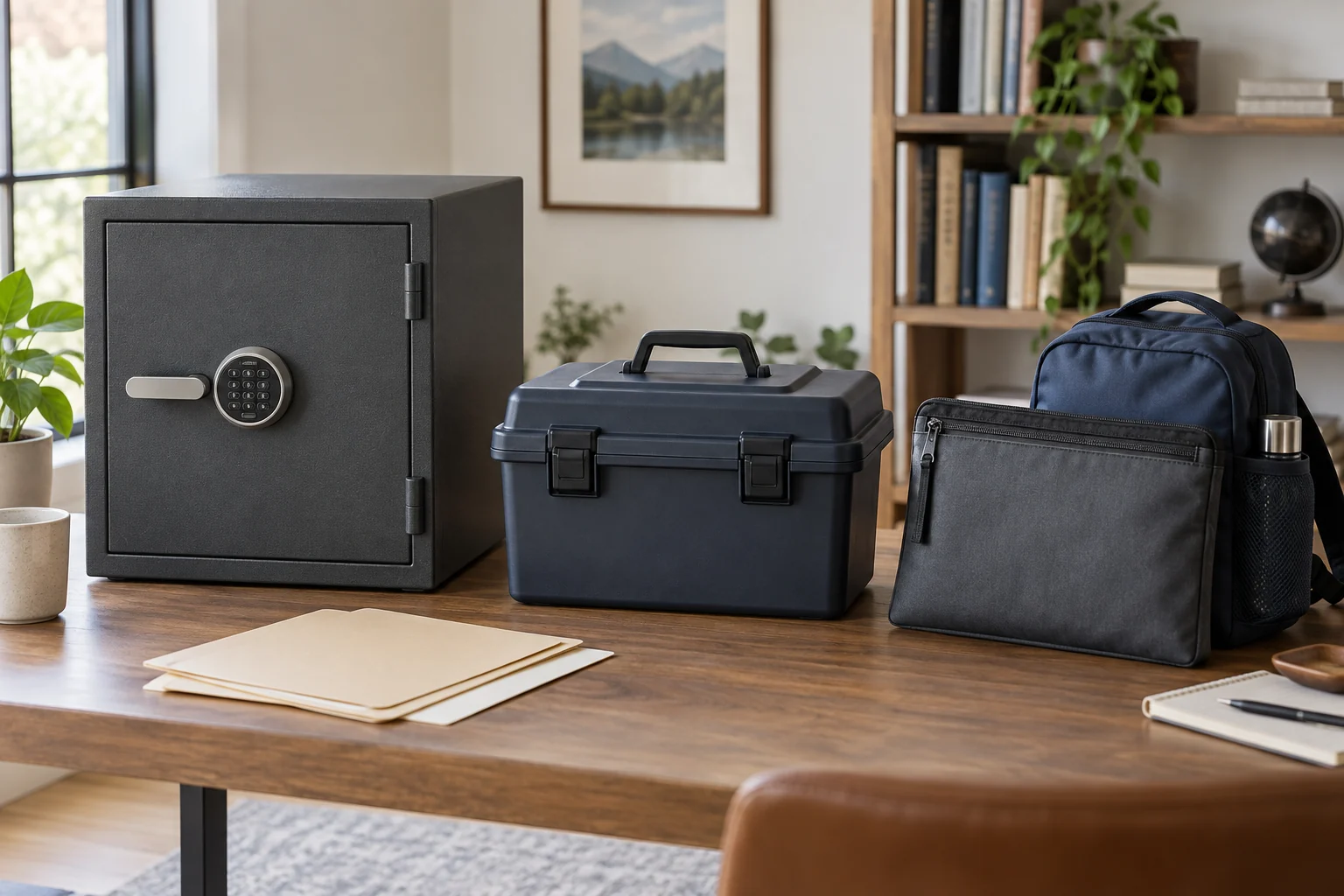
First decide what belongs in the container
Build a short list: birth and marriage records, passports, property records, insurance policies, estate documents, vehicle titles, account-recovery codes, medical directives and irreplaceable family material. Some originals are replaceable with time and fees; others may be needed immediately after an emergency.
Do not store every sensitive paper forever. Excess records increase privacy risk and make urgent documents harder to find. Use the paper-shredder guide to close the retention cycle, and keep an encrypted digital copy where legally and practically appropriate.
Separate the four hazards
- Fire and heat: can the container limit internal temperature for a stated test and duration?
- Water: is protection tested for spray, standing water or submersion, and for how long?
- Theft: can the container be carried away, pried or attacked with tools?
- Access: can authorized people retrieve critical papers during evacuation, incapacity or equipment failure?
A container can perform well against one hazard and poorly against another. A portable fire chest may protect paper in a tested fire but offer little burglary resistance. A thick steel security safe may resist casual theft but lack meaningful insulation. A water-resistant pouch may keep rain off documents while offering no verified fire protection.
Read the rating as a complete sentence
A useful rating identifies the testing organization, standard or test method, protection class, duration and sometimes impact or water conditions. UL 72 covers tests for fire resistance of record-protection equipment. A Class 350 rating is associated with paper records; heat-sensitive media can require lower internal-temperature classes. Do not infer media protection from a paper rating.
Look for the exact certification or classification on the model, manual and independent listing—not a loose phrase such as “built to standards” or an image of a badge. Verify the model number in the certifier's current directory where possible. UL provides the Product iQ certification database; access and search behavior can change, so use the current official listing as the check.
Duration matters. A 30-minute test and a two-hour test are not interchangeable. Longer is not automatically necessary for every home; the decision depends on likely response time, construction, placement and the value of the contents. No consumer safe guarantees survival in every structure fire.
Water claims need conditions
Fire response introduces water even when flooding is not the original hazard. Ask whether the water claim covers spray, a stated depth of submersion or both. Find the duration and whether the product must remain upright. “Waterproof” without test conditions is not enough to plan around.
Basements add exposure to groundwater and deeper flooding. Upper floors reduce flood risk but can increase collapse and firefighting exposure. Place the container where its rated use, anchoring instructions, floor capacity and your access needs can all be met.
Paper, drives and photographs are different contents
Paper protection does not establish protection for flash drives, hard drives, optical media, film or photographs. Electronics and magnetic media can be damaged at lower temperatures and by moisture. The safer default is to keep an independent encrypted digital copy off-site rather than treating a paper document safe as a universal media vault.
Moisture can accumulate in insulated containers during ordinary use. Follow the manufacturer's airing and desiccant guidance, and inspect papers for dampness or odor. Do not seal irreplaceable media in an unmonitored box for years and assume the fire label covers storage conditions.
Choose the category by job
Rated document safe
Best when a fixed collection of paper originals needs documented fire protection and some access control. Check verified rating, interior dimensions, loaded weight, floor support, anchoring instructions, lock power and override process. A fire safe is not automatically a burglary safe.
Portable fire document chest
Best for a smaller paper set and renters who cannot install a heavy safe. Confirm the complete rating and water conditions. Its handle improves movement for you and for a thief, so avoid treating portability as security.
Grab-and-go document pouch
Best for copies or originals that must travel during an evacuation. Use the pouch to organize and protect from ordinary handling and weather only to the extent verified. Do not rely on vague high-temperature fabric claims as a substitute for a tested record container.
Bank safe-deposit box or trusted off-site storage
Useful for originals not needed during immediate evacuation and for geographic separation. Access may be limited by hours, authorization or a wider disaster. Confirm the institution's terms and keep an inventory; do not place the only immediately needed copy out of reach.
Decision table
| Primary need | Likely fit | Main tradeoff |
|---|---|---|
| Verified paper fire protection at home | Listed document safe or chest | Weight, capacity and limited media protection |
| Evacuation access | Organized grab-and-go pouch | Portability is not fire or theft certification |
| Burglary resistance | Security-rated, anchored safe | Fire protection must be verified separately |
| Flood-prone location | Tested water protection plus off-site copy | Water conditions and placement are critical |
| Digital recovery | Encrypted off-site backup | Credentials and restoration must be maintained |
Placement is part of the system
Follow the manufacturer's installation instructions. Heavy safes can exceed the capacity of a shelf or create handling hazards. Anchoring may improve theft resistance but can conflict with water barriers or rental rules if improvised. Use a qualified installer when weight, floor structure, drilling, electrical locks or anchoring is uncertain.
Keep keys, combinations and backup access away from the container but available to authorized people. Do not publish the location in a family emergency document stored in an exposed cloud folder. Record the contents without recording more sensitive detail than the recovery person needs.
The compatibility check before purchase
- List exact contents and measure the largest folder without bending it.
- Separate paper, photographs and digital media.
- Verify the model's independent listing and full duration/class.
- Read the water-test conditions rather than the headline.
- Check exterior dimensions, door swing, weight and loaded placement.
- Confirm anchoring, battery and override instructions.
- Decide where an independent copy will live.
- Plan annual access and moisture checks.
Commercial disclosure: Life in the Simulation has no approved affiliate program for this domain, so this guide contains no paid product links. Official standards, certification and preparedness references are direct, non-affiliate links. No pictured or discussed product was tested, rated or endorsed by the publication.
What not to buy
Skip a container when the seller will not name the test, duration and model documentation behind a protection claim. Skip a pouch marketed mainly with dramatic flame photographs but no independent record-protection rating if your goal is fire survival. Skip a heavy safe that cannot be placed or anchored safely. Skip biometric-only access when the manual does not provide a practical authorized fallback.
Also skip the safe entirely if the real problem is clutter. For replaceable records, a well-organized encrypted copy and a small emergency binder may solve the need with less cost and less false confidence.
Who should skip a home safe
People who move frequently, cannot support or install the weight, need rapid evacuation access or mainly hold replaceable copies may be better served by a portable organizer and independent off-site storage. Anyone protecting unusually valuable property should use a professional security and insurance assessment; a consumer document guide cannot establish adequate burglary protection or coverage.
Build the document system, not just the box
Ready.gov recommends preserving important documents and considering fireproof and waterproof storage. Its financial-preparedness guidance also emphasizes access to records after a disaster. FEMA's document-copy guidance recommends keeping important papers safe and accessible.
The practical system has three layers: originals protected for the likely hazard, copies available for recovery and a portable subset for evacuation. Test access once a year. Replace stale IDs and policies. Confirm the trusted person can find the inventory and use the backup access.
Official sources and check-before-you-buy links
- UL 72, Tests for Fire Resistance of Record Protection Equipment, for the relevant test standard.
- UL Product iQ, for current certification listings.
- Ready.gov Financial Preparedness and FEMA document-copy guidance, for preparedness context.
- Standards, listings and manufacturer instructions can change. Verify the exact model and current documentation before purchase or installation.
END OF FIELD GUIDE 055
Keep the question. Test the model.
Choose the narrowest claim the evidence can carry, then leave room for revision.