A paper shredder has one job: make discarded information hard enough to reconstruct for the risk at hand. The difficult part is not finding the machine with the most dramatic security label. It is choosing a destruction path your household or office will actually use without jams, unsafe shortcuts or a permanent backlog beside the bin.
This guide compares broad categories, not specific product performance. Manufacturer specifications vary by exact model and market. Verify the current manual, cut description, duty cycle, accepted materials, safety features and warranty before buying.
First decide what should be destroyed
Shred documents that expose information you would not want recovered from ordinary waste: financial account details, tax identifiers, medical or insurance information, signatures, unused checks, expired IDs where lawful, and records containing another person's private data. Follow legal, tax, employment and contractual retention requirements before destruction.
Do not keep paper merely because disposal feels complicated. The Personal Data Minimization framework starts earlier: collect less, retain it for a defined reason and set a deletion date. A shredder handles the last step; it cannot repair excessive collection.
Strip-cut, cross-cut and micro-cut solve different problems
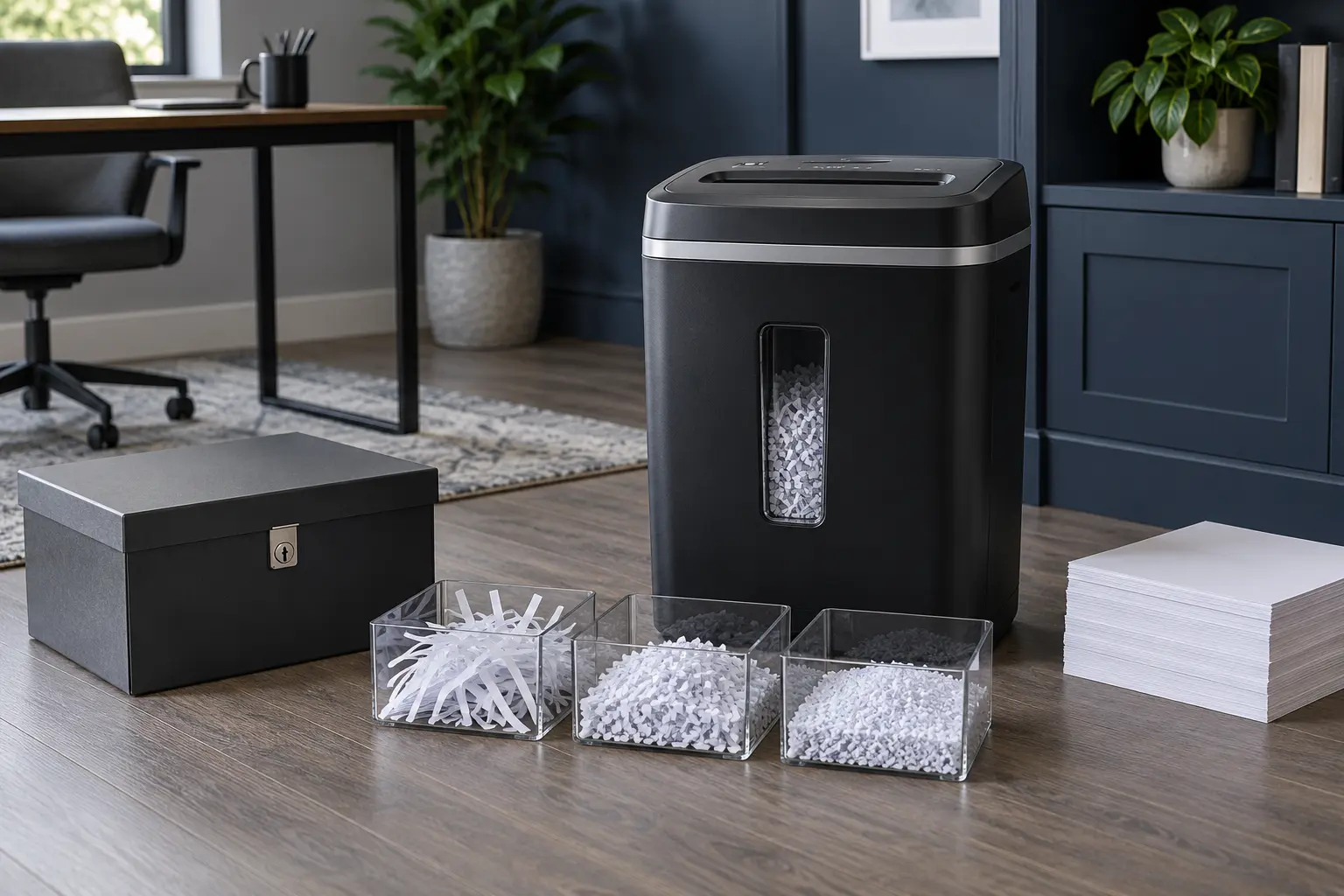
Strip-cut machines slice a sheet into long ribbons. They can be fast and simple, but the large fragments preserve more structure and fill a bin inefficiently. Use them only where the documents are low sensitivity and the resulting fragments meet your actual policy.
Cross-cut machines cut in two directions, creating shorter particles. For ordinary household financial and identity papers, this is often the practical center: materially smaller fragments without the highest price, noise, maintenance or throughput penalty associated with finer cuts.
Micro-cut is a marketing category for still smaller particles. Exact dimensions and standardized security ratings vary, so verify the specification rather than relying on the word alone. Finer particles can improve destruction and bin capacity, but the mechanism may process fewer sheets at once and demand more patient feeding and maintenance.
If an employer, regulator, client or contract specifies a destruction standard, follow that requirement. A generic consumer category comparison cannot establish compliance.
Match the method to the threat
Most households are defending against casual recovery from recycling or trash, not a laboratory reconstruction effort. Cross-cut destruction, prompt disposal and mixing material may be proportionate. A business handling client records, regulated data or high-volume archives has different obligations and may need documented chain of custody and certified destruction.
Ask what an adversary could gain, how accessible the waste is, whether the information exists elsewhere and what consequence follows from exposure. The Personal Threat Modeling guide keeps the response proportional.
Ignore the heroic sheet count until you read the duty cycle
A maximum sheet claim describes a test condition, not a comfortable daily workflow. Paper weight, folds, humidity, staples and feed alignment change the load. Continuously feeding the published maximum invites jams and thermal shutdown.
Check five separate specifications:
- Recommended or maximum sheets per pass. Plan to feed below the ceiling.
- Continuous run time. This determines whether a monthly pile becomes several cooling cycles.
- Cool-down time. A small machine may stop long before the pile is gone.
- Bin volume and fullness visibility. Fine particles pack differently from strips.
- Accepted materials. Paper clips, staples, cards, discs, labels and envelopes are model-specific.
Estimate your real batch. Count one ordinary month's pages and the largest annual purge. If the annual box is the only heavy job, paying a service once may be better than owning a machine sized for one afternoon.
Manual feed, auto feed or service
Manual-feed shredders fit small, frequent batches. They require presence but make it easier to inspect each document and remove materials the machine does not accept.
Auto-feed shredders can reduce standing time for uniform stacks. Check whether the machine secures unattended paper, how it handles staples and mixed sizes, and whether the advertised capacity applies to the auto tray or manual slot. Convenience does not eliminate sorting.
A shredding service fits large purges, business records or households that do not want another motorized appliance. Ask whether destruction is witnessed or off-site, how containers are secured, what proof of destruction is supplied, and whether the provider's certification and scope match your need. The i-SIGMA directory can help identify services holding current NAID AAA certification; certification is evidence of audited process, not a guarantee that every service fits every legal obligation.
Treat the feed slot as a moving-machine hazard
The U.S. Consumer Product Safety Commission warns that paper shredders can cause severe finger injuries, especially to young children. Keep children and pets away during use. Place the machine where it cannot be reached casually, keep hands and loose clothing away from the opening, and disconnect power before clearing or cleaning it according to the manual.
Do not let a child “help” by feeding paper. Do not defeat guards or sensors. Do not reach into the slot, even when the machine appears stopped. Use the manufacturer's documented reverse and jam-clearing procedure, and replace a damaged cord or enclosure rather than improvising a repair.
Safety matters more than an extra sheet of capacity. A narrower slot, lockout control, guarded feed and stable base can be more valuable in a household than speed.
Maintenance is part of the purchase
Cross-cut and micro-cut mechanisms may require lubrication. Use only the method and material named in the exact manual; oils and schedules are not universal. Empty the bin before packed paper reaches the cutter, remove dust as directed with power disconnected, and stop when the machine signals heat or overload.
Labels, adhesive envelopes and materials outside the manual can gum a cutter. Shredding cards or discs may require a dedicated slot and can create sharp fragments. “It fit through the opening” is not a compatibility test.
Build the destruction workflow before buying
- Place a closed “to shred” container where paper is processed, away from children and public access.
- Sort documents into retain, scan, shred and ordinary recycle.
- Scan only records that need a digital copy; use the scanner guide to avoid digitizing clutter.
- Schedule a small weekly batch so the machine is not asked to process a year's backlog.
- Empty fragments into the waste stream allowed by local recycling rules; shredded paper is not accepted everywhere.
- Review the retained-paper list annually and record business destruction when policy requires it.
If a scanned copy remains, paper destruction has not deleted the information. Secure and eventually delete the digital copy under its own retention plan. Encrypted Cloud Storage Without the Hype explains part of that custody decision.
What not to buy
Do not buy by maximum sheet count alone. Do not assume “micro-cut” establishes a legal security level. Do not buy a tiny intermittent machine for a recurring office archive. Do not buy an industrial-capacity unit for three envelopes a week. Do not pay for card or disc destruction when your policy forbids feeding those materials into a general machine.
Skip ownership if you cannot store the shredder safely, will not maintain it, or generate one large purge rather than steady volume. A vetted service can be the more secure and less wasteful tool.
The five-minute decision
- Household, a few pages each week: start with a cross-cut manual-feed category and a child-safe placement plan.
- Very low-sensitivity internal paper: strip-cut may be adequate if the larger fragments meet the actual risk and policy.
- Higher-sensitivity household records: compare verified particle dimensions, duty cycle and safety features in cross-cut and micro-cut models.
- Large seasonal purge: price a documented shredding service before buying a high-capacity machine.
- Regulated or client records: follow organizational, legal and contractual requirements; use a qualified records-management or destruction provider when appropriate.
Commercial disclosure
The manufacturer, retailer-category and service-directory links below are direct, non-affiliate references. Life in the Simulation has no approved affiliate program configured for this domain and receives no commission from them. No shredder was hands-on tested for this guide. Prices, availability and model specifications can change; verify the exact item and manual before purchase.
Official safety and shopping references
- U.S. Consumer Product Safety Commission, Paper Shredder Safety Alert (PDF, Publication 5127).
- i-SIGMA, NAID AAA Certification and certified service directory.
- Fellowes, current shredder category specifications and safety features.
- Fellowes, manufacturer maintenance FAQ; always follow the exact model manual.
- Staples, current paper-shredder category for non-affiliate product-intent comparison.
END OF FIELD GUIDE 041
Keep the question. Test the model.
Choose the narrowest claim the evidence can carry, then leave room for revision.