An indoor-air monitor can reveal a ventilation problem, a cooking plume, smoke infiltration or a radon pattern. It can also display a polished score that merges unlike signals, encourages constant checking and implies more certainty than the sensors support.
Start with the pollutant, not the dashboard. Carbon dioxide, fine particles, volatile organic compounds, carbon monoxide and radon are different substances or indicator classes. They require different sensing methods and lead to different actions. A device that measures one should not be treated as evidence about the others.
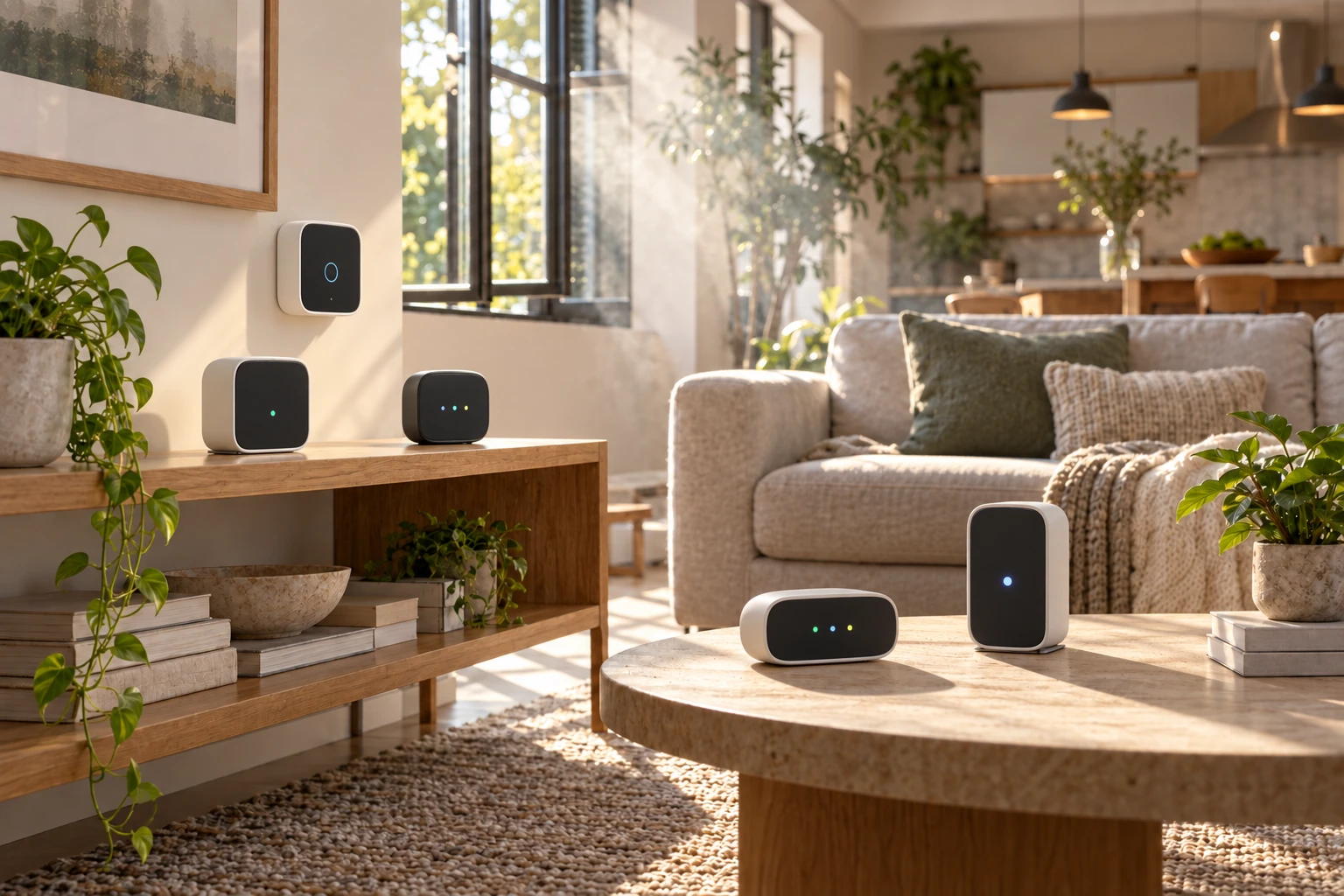
What the common signals mean
| Signal | What it can help reveal | What it does not establish |
|---|---|---|
| CO₂ | Occupancy and ventilation patterns in a room | Carbon monoxide safety, total air cleanliness or infection risk by itself |
| PM2.5 | Fine-particle changes from smoke, cooking and other sources | The chemical identity or toxicity of every particle |
| VOC/TVOC | Changes in a broad sensor response to some gases | A complete inventory, compound-specific concentration or health diagnosis |
| Radon | Longer-term radioactive-gas concentration patterns | A complete result from a brief spot reading |
| CO | Dangerous carbon-monoxide accumulation when measured by a listed alarm | A substitute for required life-safety alarms if the device is only an informal monitor |
| Temperature/humidity | Comfort and conditions that affect some sensors and moisture | Pollutant concentration |
The U.S. Environmental Protection Agency says low-cost monitors use one or more sensors to detect specific pollutants or environmental factors. It also cautions that they are not equivalent to regulatory monitoring systems. That is the correct mental model: a consumer sensor can be an informative instrument for patterns and interventions without becoming a laboratory.
CO₂: useful ventilation indicator, not a safety total
People exhale carbon dioxide, so indoor CO₂ often rises with occupancy when outdoor-air exchange is limited. Watching the trend can help compare a closed bedroom, an open door, a running ventilation system or a crowded meeting. For this use, look for a true nondispersive infrared sensor, a readable trend history and a way to export data if you want analysis beyond the app.
CO₂ is not carbon monoxide. The similar abbreviations invite a dangerous category error. A CO₂ display does not replace a carbon-monoxide alarm. It also does not measure particles, radon or every indoor contaminant. Ventilation may reduce several pollutants, but the CO₂ number is still one indicator shaped by occupancy, room volume, outdoor concentration and sensor behavior.
PM2.5: good for episodes and response tests
Fine-particle sensors can make a cooking event, candle, wildfire-smoke intrusion or filtration change visible. Many low-cost devices estimate particle concentration optically by detecting scattered light. Particle composition, humidity, aerosol size and calibration affect the estimate, so different devices may disagree.
Use repeated patterns more confidently than a single dramatic value. Place the monitor away from the immediate stove plume if you want room exposure rather than source intensity. When outdoor smoke is the question, compare with official outdoor observations and guidance. A consumer indoor monitor can show whether conditions changed; it does not determine compliance with outdoor air standards.
VOC: broad signal, narrow conclusions
VOC sensors are often the easiest feature to over-interpret. “Volatile organic compounds” names a large group. A consumer sensor may respond to multiple gases with different sensitivities and report a combined index or estimated total. Cleaning products, cooking, fragrance, alcohol and humidity can move the response.
A spike can prompt ventilation, source removal and observation. It cannot reliably name the chemical or diagnose a health effect unless the device and method are specifically designed and validated for that compound. If a persistent odor or suspected exposure creates a serious concern, consult a qualified indoor-environment or health professional rather than shopping for a more colorful TVOC score.
Radon: measure long enough
Radon is a radioactive gas that can enter buildings from the ground. EPA recommends testing all homes and explains that short-term tests are useful for initial information while long-term tests better reflect the year-round average. A continuous radon monitor can make trends convenient, but the measurement window and placement still matter.
Use EPA or state guidance for test location, duration, confirmation and mitigation. Do not place a general-purpose air monitor in a room and assume its absence of a radon feature means low radon. If radon is the decision, use a device or test kit intended for radon.
Carbon monoxide: life-safety device first
Carbon monoxide is colorless and odorless. Treat it as a life-safety problem, not a hobby dashboard. Follow local code and U.S. Consumer Product Safety Commission guidance for installing CO alarms. A multipurpose monitor should not replace listed, properly located alarms unless its documentation explicitly establishes that function and applicable requirements are met.
If an alarm sounds or poisoning is suspected, leave the area and follow emergency guidance. Do not wait for a phone app, compare graphs or use a second consumer sensor to adjudicate the warning.
A category-first buying card
- Decision: ventilation, wildfire smoke, cooking, radon, moisture or life safety.
- Sensor: confirm the exact measured quantities and method, not the marketing score.
- Range and resolution: check whether specifications cover the conditions you care about.
- Accuracy statement: look for documented tolerances, test conditions and calibration behavior.
- History: decide whether on-device viewing, app history or export is necessary.
- Connectivity: local display, Bluetooth, Wi-Fi, cloud account, API and offline behavior.
- Privacy: app permissions, account requirement, data sharing and deletion controls.
- Power: battery life, replaceability, cable location and outage behavior.
- Maintenance: calibration, drift, cleaning, sensor life and support documentation.
- Verification: the official test, reference monitor or second method used when stakes rise.
If cloud dependence is unnecessary, apply the smart-home control-stack checklist. A screen on the device can be more resilient and private than an app-only design. If continuous recording is useful, confirm that export remains possible if the vendor service changes.
Placement changes the answer
Define the question before placing the sensor. A monitor beside a stove measures a source plume; across the room it measures a mixed-room response. One beside an open window may track outdoor exchange more than the breathing zone. Heat, steam and direct airflow can distort some readings.
Follow the manufacturer's placement instructions for the exact sensor and EPA guidance for the pollutant. Keep a short placement note with the data. Moving the device without recording the move creates a false trend.
Run an intervention test
Collect a baseline for several comparable periods. Change one thing: open the window, run the exhaust hood, use a portable filter, reduce a source or change occupancy. Record time, room, weather and activity. Compare direction, peak, duration and recovery—not only the app's summary color.
Repeat before buying more devices. The one-person experiment protocol provides a baseline, one-variable change and stop rule. It turns monitoring into a question with an action rather than a permanent anxiety feed.
The no-buy path
- Use official outdoor air data when the question is regional smoke or pollution.
- Borrow a sensor through an EPA-listed or local library loan program when available.
- Use a certified radon test kit for a radon decision rather than a general dashboard.
- Install required smoke and CO alarms before buying wellness-oriented monitors.
- Fix known sources and ventilation failures instead of measuring them indefinitely.
- Ask whether an existing thermostat, purifier or building system already exposes the needed sensor—with documented limits.
Use manufacturer pages as specification sheets
Current products illustrate category differences without proving superiority. Aranet4 documents a portable NDIR CO₂ monitor with local display and Bluetooth. AirGradient ONE documents CO₂, particulate and gas-sensor features with an open-hardware orientation. Airthings View Plus documents a broader connected set including radon. Compare exact sensor list, calibration, data path and required account against your buying card; do not treat feature count as quality.
Specifications, apps and cloud policies change. Recheck the current manufacturer documentation immediately before purchase. For safety-critical or health decisions, prefer the relevant agency protocol or qualified professional over a category comparison.
Claims and boundaries
Sourced fact: EPA distinguishes pollutants, explains uses and limitations of low-cost monitors, and provides separate radon guidance; CPSC provides CO-alarm guidance. Manufacturer fact: linked product pages describe current sensor categories and connectivity, not independent performance. Inference: defining the action before the sensor reduces waste and over-interpretation. Not claimed: a consumer monitor diagnoses illness, proves a room safe, meets a regulatory method or was tested by this publication.
Official and manufacturer references
- U.S. EPA: Low-Cost Air Pollution Monitors and Indoor Air Quality, for pollutant categories and consumer-monitor limits.
- U.S. EPA: Radon, for testing, interpretation and mitigation pathways.
- U.S. CPSC: Carbon Monoxide Questions and Answers, for alarm and emergency guidance.
- U.S. EPA: Air Sensor Loan Programs, for borrowing opportunities.
- Aranet4 manufacturer specifications, a CO₂-monitor category example.
- AirGradient indoor monitor specifications, a multisensor/open-hardware example.
- Airthings View Plus specifications, a connected radon/multisensor example.
END OF FIELD GUIDE 079
Keep the question. Test the model.
Choose the narrowest claim the evidence can carry, then leave room for revision.