A smart plug is a switch with dependencies. The box may also contain a radio, schedule engine, power meter, account relationship and path to a remote service. Buying by voice-assistant logo hides the important questions: what load is being controlled, what infrastructure is required and what happens when the network, cloud or vendor disappears?
Start with the job. A lamp that should turn on at sunset, a coffee station that must be physically off overnight, and an energy-measurement experiment have different requirements. The simplest reliable control may be a mechanical timer. “Smart” is useful only when the extra state and remote control solve a real problem.
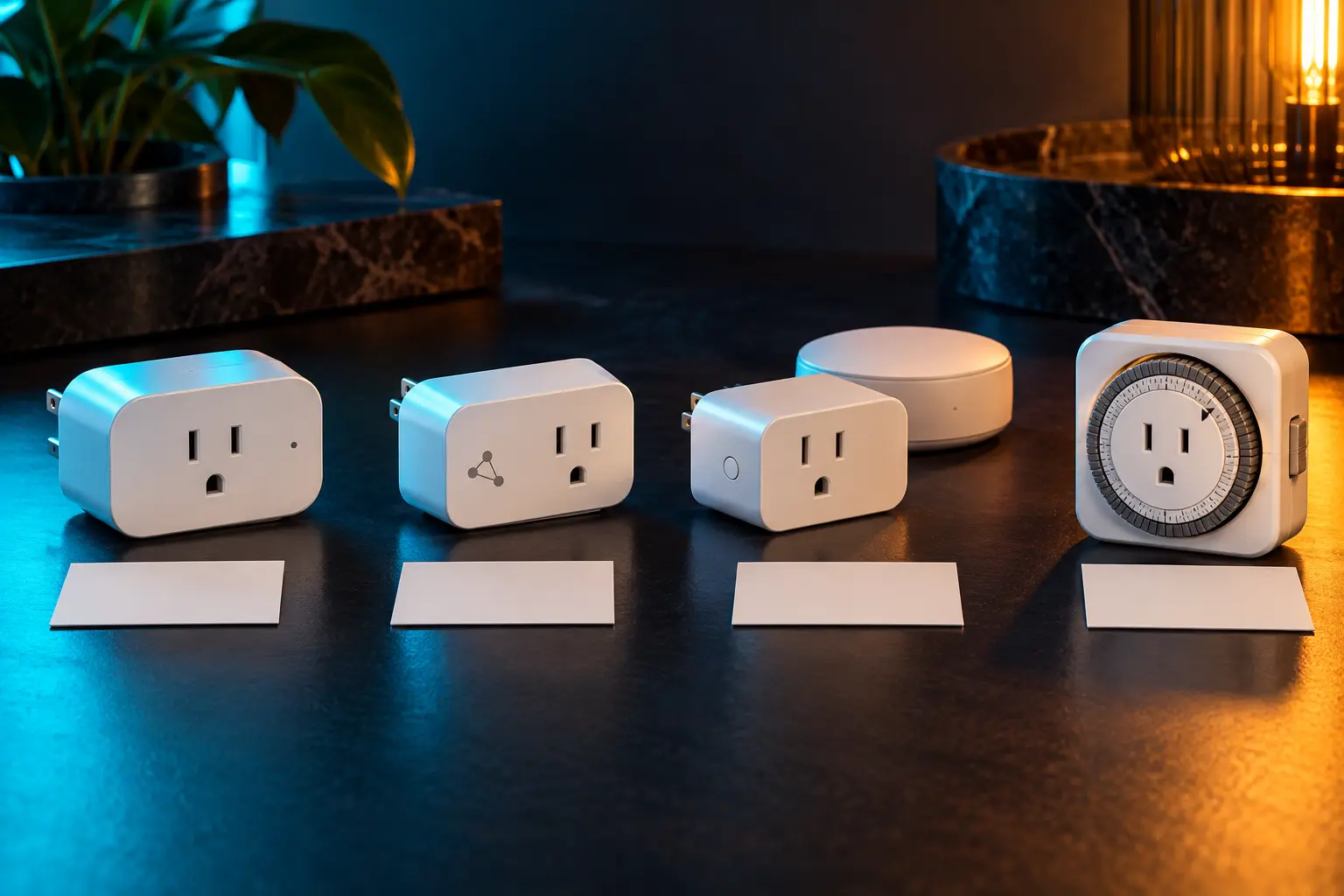
Five architectures, not four brands
| Path | Infrastructure | Best fit | Main tradeoff |
|---|---|---|---|
| Mechanical or digital timer | Outlet only | Fixed local schedules | No remote state or flexible automation |
| Proprietary Wi-Fi plug | Wi-Fi, usually vendor app/account | One or two devices with minimal hardware | Router, cloud and support dependencies vary |
| Matter over Wi-Fi | Wi-Fi plus a Matter controller | Cross-ecosystem basic control | Matter support does not guarantee every vendor feature transfers |
| Matter over Thread | Matter controller plus Thread border router | Low-power IP mesh where Thread infrastructure already exists | Buying the plug may expose a missing controller or border router |
| Zigbee plug | Zigbee coordinator or compatible bridge | Established local mesh and repeater role | Bridge compatibility and exposed features are system-specific |
Matter is an application-layer interoperability standard, not a radio. A Matter plug can communicate over Wi-Fi or Thread. A Thread border router connects the low-power Thread mesh to other IP networks; it is not the same role as a Matter controller, though one device may contain both. A bridge translates or exposes devices from another ecosystem such as Zigbee. The hub guide explains those roles before the marketing collapses them into one word.
Electrical fit comes before connectivity
Read the exact plug and appliance labels. Verify voltage, current, wattage, grounded connection, indoor or outdoor rating, enclosure, operating environment and permitted load type. A plug rated for one simple resistive load may have different limits for motors, transformers or other startup currents. Do not infer compatibility from outlet shape or a large maximum-watt number.
Use a product certified for the applicable market by a recognized testing laboratory and inspect the actual certification record when consequence is high. A logo in a marketplace image is not the record. Leave the adjacent receptacle accessible if the device design permits, and do not stack adapters or bury a heat-producing connection behind furniture contrary to instructions.
Do not use a smart plug or timer to remotely operate a portable space heater. The U.S. Consumer Product Safety Commission says electric space heaters should be plugged directly into a wall outlet, not a power strip or extension cord, and should not be left operating unattended. More broadly, never automate equipment whose unattended restart, loss of power or return after an outage can create fire, flooding, movement, medical or safety risk. Follow the appliance manual.
Name the control job
- Fixed schedule: a timer may be the most resilient and private answer.
- Presence simulation: local schedules and randomized routines may matter more than energy reporting.
- Remote confirmation: verify whether the system reports commanded state, measured power or only its last known state.
- Energy experiment: check measurement resolution, units, export, retention and whether the figure is suitable only for rough comparison.
- Automation input: determine which conditions are evaluated locally and which require the internet or cloud.
- Mesh extension: some powered Zigbee or Thread devices can help their mesh, but confirm the exact certified role and placement rather than assuming every plug does.
A smart plug is not a surge protector, circuit breaker, energy-management system or safety interlock unless the exact product is certified and documented for that role. The surge-protection guide covers the separate job of transient protection.
Ask what local control really means
“Local” can mean that schedules execute on the plug, that a controller can send commands without a vendor cloud, or merely that the phone is on the same network during setup. Ask separately:
- Will the physical button switch the load without internet?
- Will a saved schedule run without internet, Wi-Fi or the hub?
- Can the home platform control it locally if the vendor service is unavailable?
- Can remote control work without the vendor account?
- After a power outage, does it return on, stay off or restore the prior state?
- Can the device be reset and commissioned to another controller if the account or vendor disappears?
The Connectivity Standards Alliance describes Matter as local connectivity, while noting that away-from-home control generally needs an internet-connected controller. Multi-admin can let a Matter device join more than one ecosystem, but setup, feature exposure and account requirements still depend on current controllers and device software.
Use current products only as architecture examples
Official documentation shows the distinction. TP-Link's Tapo P125M is a Matter-certified Wi-Fi plug that can be commissioned with compatible Matter apps. Eve Energy is a Matter-over-Thread plug and power meter; its support material says the right hub is required. The Connectivity Standards Alliance certification registry lists certified product records. These examples show architectures. They are not performance rankings, buying endorsements or evidence that every regional model has the same rating.
For Zigbee, consult the exact bridge or coordinator's compatibility list and the plug's manual. A device may pair while exposing only on/off control, omitting power data, firmware updates or advanced settings. “Works with Zigbee” is not a universal feature contract.
Energy monitoring needs a question and a reference
A built-in power meter can help identify standby draw, compare schedules or observe a rough duty cycle. It should not automatically be treated as a billing meter, laboratory instrument or diagnostic authority. Check stated accuracy range, minimum detectable load, sampling interval, displayed units and export options. Compare a known stable load if the manual permits, and record uncertainty.
The Department of Energy describes plug-load controls as one tool among inventories, meters, schedules and occupant practices. Do not buy a connected switch to save a trivial standby load without considering the plug's own energy use, purchase cost and device lifetime. Measure the problem first when practical.
Connected outlets inherit an update problem
NIST's consumer IoT baseline emphasizes capabilities such as device identification, configuration, data protection, interface access control, software update, cybersecurity state awareness and documentation. Translate that into shopping questions: Is the model uniquely identifiable? Are updates authenticated and supported for a stated period? Can unnecessary interfaces be disabled? Is vulnerability reporting available? Can the account and data be deleted?
Use unique account credentials and multi-factor authentication when offered. Remove a plug from old controllers before selling or discarding it. Keep the setup code and recovery instructions in a protected household record. If the plug controls something important, add it to the dependency map rather than pretending the app is infrastructure-free.
The twelve-minute pre-purchase test
- Photograph the appliance label and outlet location.
- Write the exact desired behavior and failure consequence.
- Check the appliance manual for permitted switching and unattended use.
- Choose timer, Wi-Fi, Matter-over-Wi-Fi, Matter-over-Thread or Zigbee by existing infrastructure.
- Verify the exact regional model in the certification registry and manufacturer manual.
- Confirm load type and electrical limits, not only headline wattage.
- Confirm schedule behavior, physical control and power-recovery state.
- List required app, account, controller, border router, bridge and internet services.
- Check update policy, reset procedure, support route and data deletion.
- Decide whether energy monitoring has a defined question.
The no-buy option
Use the appliance's built-in schedule, a wall switch, a mechanical timer or a written shutdown routine when those solve the job. Replace unsafe or failing equipment instead of automating around it. If a person only wants to know whether a device is consuming power, a borrowed meter or utility program may answer the question without creating another account and update obligation.
Who should skip a smart plug
Skip it for unattended heaters, medical or life-safety equipment, sump or pump systems, refrigeration, cooking appliances, motors or any load whose unexpected stop or restart can cause material harm unless the appliance and control are specifically designed, certified and professionally approved for that use. Skip connected control when a fixed timer meets the need or when nobody will maintain accounts and updates.
Claims and boundaries
Sourced fact: Matter can operate over Wi-Fi or Thread; Thread devices require border-routing infrastructure; current manufacturer pages document different controller and radio requirements; NIST publishes a consumer IoT security baseline. Inference: architecture and failure behavior are more durable selection criteria than ecosystem logos. Judgment: electrical fit and unattended-use consequences should be decided before connectivity. Not claimed: any named product is safest, most accurate, in stock, supported forever or tested by this publication.
Official standards, safety and manufacturer references
- Connectivity Standards Alliance: Matter FAQs, for local connectivity, controllers and away-from-home control.
- Thread Group: Border router vs hub or bridge, for the border-routing role.
- NIST IR 8425: Consumer IoT Core Baseline, for product cybersecurity capabilities and documentation.
- U.S. CPSC: 2026 space-heater safety guidance, for direct-wall connection and unattended-use warnings.
- U.S. Department of Energy: Plug Load Management, for control, metering and behavior as parts of one strategy.
- TP-Link Tapo P125M official product documentation, for one Matter-over-Wi-Fi implementation.
- Eve Energy official product documentation and CSA certification listing, for one Matter-over-Thread implementation and certified records.
END OF FIELD GUIDE 083
Keep the question. Test the model.
Choose the narrowest claim the evidence can carry, then leave room for revision.